When the ADA Health Policy Institute asked dentists about the biggest challenge facing their practices in 2025, about 62% said staffing shortages — the most common response in the poll, as reported by ADA News. If your growth plan depends on hiring more front desk people faster than the market can supply them, that plan has a problem.
The practices growing anyway have made a quiet shift. They stopped treating the front desk as a group of people behind a counter and started treating it as a set of systems those people run. That is the heart of a scalable dental front desk: one that handles more calls, more patients, and more locations without a matching increase in headcount or chaos.
Here is what that looks like in 2026 — and how to tell whether your front desk is built to grow.
What Makes a Scalable Dental Front Desk in 2026
A scalable dental front desk is one where capacity is not tied to the number of humans available at any given moment. Add a second location, a new associate, or a marketing push that doubles call volume, and the front desk absorbs it without breaking.
In practical terms, a front desk is scalable when it meets four tests:
- Every call gets answered — including lunch, after-hours, and the Monday morning rush — without hiring for peak volume.
- Workflows are documented in systems, not memorized by one person. If your best front desk coordinator wins the lottery, scheduling still works on Tuesday.
- Patient data flows automatically. Appointments, confirmations, and intake information land in the practice management system without manual re-entry.
- It works the same at every location. A patient calling office three gets the same experience as a patient calling office one.
Most solo practices fail at least two of these tests. That is fine when you are one office with a steady patient base. It becomes expensive the moment you try to grow — and the industry is growing toward multi-site models fast. According to the ADA Health Policy Institute, more than 1 in 4 dentists within ten years of dental school were affiliated with a DSO in 2024, and the trend line points up.
The Shift From People-Dependent to Systems-Dependent Operations
The traditional front desk is people-dependent. Institutional knowledge lives in the heads of two or three coordinators. Phones get answered when someone is free. Insurance verification happens when someone remembers. It works because those people are good — right up until one of them leaves.
Systems-dependent operations flip that. The workflow is defined once — how calls get triaged, how new patients get screened, how reschedules get handled — and technology executes it consistently. Your team then supervises the system and handles the judgment calls: the anxious patient, the complex treatment conversation, the billing dispute.
Writing for Group Dentistry Now, Reach CEO Cory Pinegar put it bluntly: “The front office has changed shape, but most org charts have not.” Patient requests now arrive by phone, text, and web form faster than a desk-bound team can process them. The org chart that assumes one receptionist per phone line was designed for a world that no longer exists.
This shift is not about replacing people. It is about pointing your best people at the work that actually needs a human — and letting systems carry the repetitive volume.
The Dental Front Desk Systems That Make Growth Possible
Four categories of dental front desk systems do the heavy lifting in a growth-ready operation. Here is each one and the job it owns.
1. AI call handling
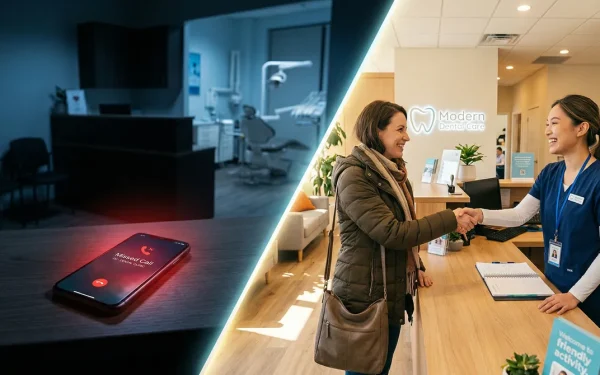
Phones are still the front door of dentistry, and they are the first thing to break under growth. Most practices miss 30–40% of inbound calls. Every one of those is a patient who may simply book with the office down the street — and many of them call when you are closed: research cited by Dental Economics found that 43% of patients look for doctors and dentists after hours.
An AI receptionist answers every call — on the first ring, or the moment your team can’t pick up — no matter how many calls arrive at once. Because call capacity does not depend on headcount, the same system covers a slow Tuesday and a post-marketing-campaign surge equally well. It schedules, reschedules, cancels, and answers routine questions, then hands off the calls that genuinely need a team member.
2. Digital check-in and intake
Paper clipboards do not scale. Digital check-in lets patients complete forms, insurance details, and health histories from their phone before they arrive. The front desk stops transcribing handwriting and starts greeting people. For multi-location groups, digital intake also standardizes the data every office collects, which makes reporting and insurance workflows consistent across sites.
3. Automated reminders and confirmations
Manually calling tomorrow’s patients is the classic example of skilled people doing unskilled work. Automated text and email reminders handle confirmations at any volume, and two-way texting lets patients confirm or ask to reschedule without tying up a phone line. Your team only touches the exceptions — the patient who needs to move, the family with four back-to-back appointments.
4. Real-time practice management system integration
This is the layer that turns separate tools into one operation. When your call handling, reminders, and check-in all read and write to the practice management system in real time, the schedule is always current and nothing gets double-booked or re-typed. Without it, “automation” just creates a new manual job: copying data between systems.
Patients expect this level of coordination now. In a Healthgrades study cited by Dental Economics, 80% of consumers said they would prefer to book their healthcare appointments online — the same instant, self-service experience they get everywhere else.
Scaling Across Multiple Locations
Everything above gets harder — and more valuable — when you operate more than one office. Multi-location owners and DSO operations leads face three problems a solo practice never sees:
- Consistency. Ten offices means ten versions of “how we answer the phone” unless the workflow is defined centrally and executed by systems.
- Visibility. You cannot stand at ten front desks. You need call logs, recordings, and performance metrics you can review from anywhere.
- Patients who cross locations. A patient who normally visits your downtown office will eventually call your northside office. If that office treats them like a stranger, the experience breaks — and so does the schedule when someone books them in the wrong place.
A scalable setup solves all three: one standard workflow customized per location where it should differ (providers, hours, policies), central reporting, and systems that recognize patients across the whole group instead of one office at a time.
How Dentina.Ai Helps
Dentina.Ai is an AI dental receptionist built for exactly this systems-dependent model — made for dentists, by a dentist.
- Every call answered, 24/7. Dentina answers with a 100% answer rate and no cap on simultaneous calls, so call capacity never depends on headcount. It resolves 94% of calls without a human transfer, and hands the rest to your team with context.
- Real-time PMS integration. Dentina reads and writes appointments in major practice management systems — including Open Dental, Dentrix Ascend, Curve Dental, Eaglesoft, Cloud9, Denticon, Dolphin, and OrthoTrac — through a trusted integration partner, so the schedule stays current without re-entry.
- Customizable per location. Greetings, scripts, screening questions, call routing, scheduling policies, and provider availability are configured for each office, so every location sounds like itself while running the same underlying system.
- Cross-location patient search and scheduling. For multi-location groups, offices can be pooled so a patient who normally visits Location A and calls Location B is recognized instead of treated as new. Dentina confirms which office they want to book at, and routes cancellations or reschedules that belong to another office to the right place rather than touching another office’s schedule.
- Oversight built in. After every call, staff get an email summary with transcripts and recordings, and an online portal shows call logs and performance metrics across offices.
- Ten languages. Dentina handles calls in English, Spanish, French, German, Hindi, Russian, Portuguese, Japanese, Italian, and Dutch.
- Built for healthcare. Dentina operates under HIPAA-compliant policies, provides a Business Associate Agreement, and runs on Microsoft Azure.
The results follow the systems logic: practices using Dentina book 21 appointments per office per month on average, worth $5K–$10K+ in production value per month — capacity captured from calls that used to go to voicemail.
Build the Front Desk That Grows With You
A scalable dental front desk is not a bigger team — it is a better-designed one. Define your workflows, put systems behind the repetitive volume, connect everything to your PMS in real time, and give your people the work only people can do. Do that at one location and adding the second gets dramatically easier.
If the phones are where your front desk breaks first, that is the easiest place to start. Dentina.Ai comes with a 30-day free trial, no setup fees, and a month-to-month agreement — book a demo and see how it fits your growth plan.
Frequently Asked Questions
What is a scalable dental front desk?
A scalable dental front desk is a front office operation whose capacity does not depend on headcount. Calls, scheduling, reminders, and intake run on documented systems — AI call handling, digital check-in, automated reminders, and real-time PMS integration — so the practice can add patients, providers, or locations without the front desk becoming a bottleneck.
What systems does a growth-ready front desk need?
Four core dental front desk systems cover most of the work: AI call handling that answers every call 24/7, digital check-in and intake forms, automated appointment reminders and confirmations, and real-time integration with the practice management system. The integration layer matters most — it is what keeps the other three from creating duplicate data entry.
Does AI call handling replace front desk staff?
No. AI call handling absorbs the repetitive phone volume — scheduling, rescheduling, routine questions — so your team can focus on patients in the office, complex conversations, and insurance work. Dentina.Ai resolves 94% of calls without a human transfer and hands off the calls that need a person, with a summary and recording attached.
How do multi-location dental groups handle patients who call the wrong office?
The strongest setups pool patient recognition across the group. With Dentina.Ai’s cross-location patient search and scheduling, a patient who normally visits one office and calls another is recognized rather than treated as new. Dentina confirms which office they want to book at, and if they ask about an appointment that belongs to a different office, it routes them there instead of changing another office’s schedule.
Sources
ADA News — Five Years Later: Staffing Shortages, Infection Control Since the COVID-19 Pandemic (2025) ·
ADA News — HPI: More New Dentists Affiliated with DSOs (2025) ·
Group Dentistry Now — The Dental Front Office Has Left the Building (2026) ·
Dental Economics — Why Online Scheduling Should Be the New Normal (2021)