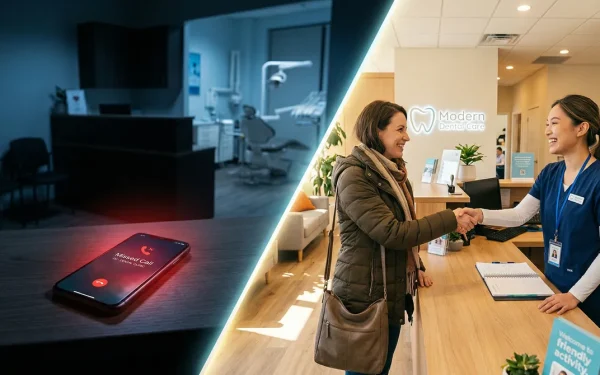
A Peerlogic study tracking 4,280 inbound calls across 26 dental practices found that 38% went unanswered — during normal business hours. That means more than one in three potential patients heard ringing, voicemail, or hold music instead of a human voice. For practices spending thousands on marketing to make the phone ring, missed dental patient calls represent one of the largest and least visible drains on revenue.
This article breaks down exactly how many calls your practice is likely missing, why they slip through the cracks, and what each one costs you in real dollars. If you’ve ever wondered whether missed dental patient calls are quietly undermining your growth, the data will give you a definitive answer — along with a clear path to fix it.
Key takeaways: Dental practices miss 35–38% of incoming calls on average, and 78% of those callers never leave a voicemail — they simply call another office (DenteMax). Each missed new patient call costs roughly $850 in first-visit revenue and $5,000–$8,000 in lifetime value. The biggest culprits are lunch breaks, call stacking during peak hours, and understaffing. AI-powered call handling platforms like Dentina.Ai now offer a 100% live-answer rate with direct PMS scheduling, eliminating the gap entirely.
- How Many Dental Patient Calls Actually Go Unanswered?
- Why Your Front Desk Misses So Many Calls
- The Real Revenue Impact of Missed Dental Patient Calls
- Why Traditional Solutions Fall Short
- How AI Call Handling Eliminates Missed Dental Patient Calls
- What to Do This Week to Start Recovering Lost Revenue
- Conclusion
- Frequently Asked Questions
How Many Dental Patient Calls Actually Go Unanswered?
The numbers are worse than most practice owners realize. Industry research consistently places the unanswered call rate for dental offices between 35% and 40%. A 2026 Peerlogic case study — one of the largest of its kind — tracked every inbound call across a 26-practice dental group and found that 38% went unanswered. Resonate AI puts the average at roughly 300 missed calls per month for a typical practice.
The average dental practice misses approximately 300 calls per month. At even a modest conversion rate, that’s dozens of lost patient opportunities every 30 days.
But the raw miss rate only tells part of the story. To understand the full cost of missed dental patient calls, you need to look at what happens after the caller hears silence.
What Happens When Patients Reach Voicemail
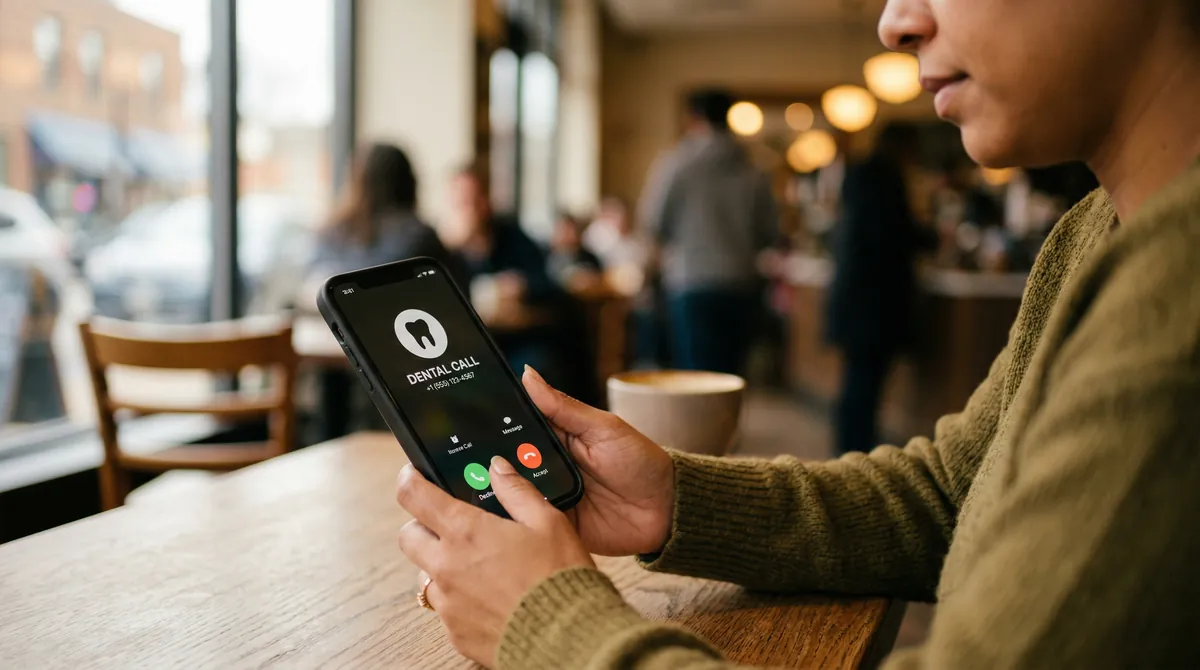
Most callers don’t wait around. According to industry benchmarks cited by DenteMax and others, 78% of patients who reach voicemail hang up without leaving a message. They don’t try again later. They don’t send an email. They move on.
And where they move is the real problem: 67% of patients who can’t get through to a dental office call a competitor immediately. The patient was ready to book. Your marketing worked. But the front desk couldn’t pick up — and that patient is now sitting in someone else’s chair.
| Caller Outcome | Percentage |
|---|---|
| Hangs up without leaving a voicemail | 78% |
| Calls a competing dental office | 67% |
| Leaves a voicemail | 14–22% |
| Tries calling back later | ~10% |
The pattern is clear: voicemail is not a safety net. It’s a trapdoor.
Why Your Front Desk Misses So Many Calls
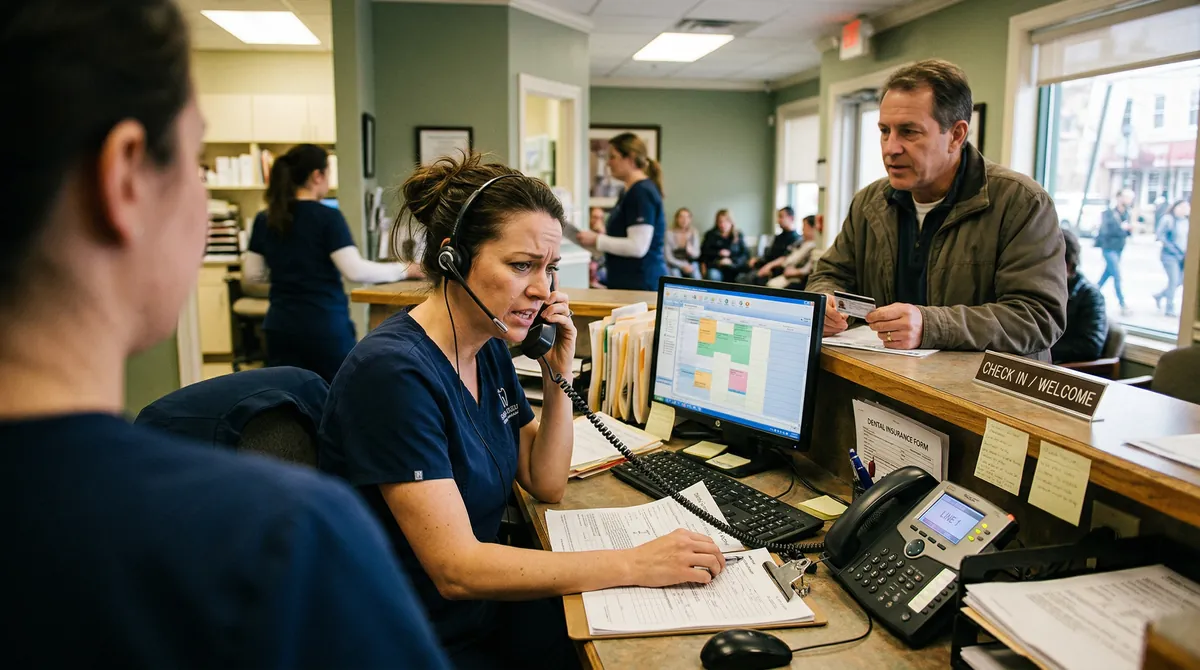
It’s tempting to blame the receptionist, but the real issue is structural. Most missed dental patient calls aren’t caused by negligent staff — they’re caused by front desks that are designed to fail at phone coverage because they’re asked to do too many things at once.
The Lunch Hour and After-Hours Gap
Call volume doesn’t stop when your team takes lunch. In fact, midday and late afternoon are peak calling windows — patients call during their own breaks. Yet many practices still route phones to voicemail between 12:00 and 1:00 PM. After 5:00 PM, the phones typically go dark entirely. DenteMax reports that during these gaps, missed call rates can exceed 50%.
Hold Times and Call Stacking
A single receptionist can handle one call at a time. When two or three calls arrive simultaneously — common during Monday mornings and post-weekend rushes — callers two and three are placed on hold or sent to voicemail. This is call stacking, and it’s the primary driver of missed dental patient calls during peak hours. Most practices don’t realize it’s happening because their phone system doesn’t report on it.
Understaffing and Multitasking
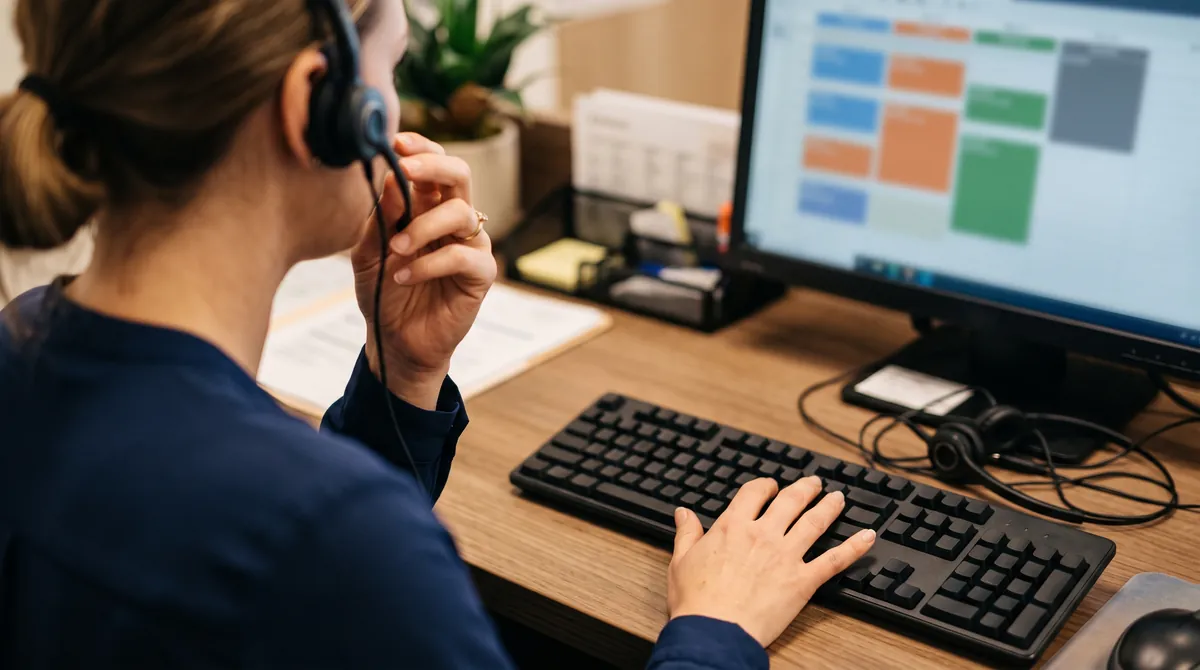
Consider what a typical front desk coordinator juggles in any given hour: greeting walk-in patients, verifying insurance, processing payments, confirming tomorrow’s appointments, and answering the phone. When a patient is standing at the counter and the phone rings, the in-person patient wins every time. The caller gets voicemail.
Picture a 5-operatory practice on a Monday morning. Three patients are checking in. The hygienist needs a chart pulled. Insurance is calling back about a pre-authorization. And two new patients — the ones your Google Ads budget worked hard to attract — are calling to book their first appointments. One gets through. The other hears four rings and silence.
The Real Revenue Impact of Missed Dental Patient Calls
Every missed call carries a price tag. For existing patients, it’s an inconvenience that can erode loyalty. For new patients, it’s money that walks out the door and never comes back.
According to data from the Dental CPA and Peerlogic, the average first-visit value of a new dental patient falls between $750 and $1,000, depending on the services performed. A commonly cited midpoint is $850. That’s the revenue from a single new patient’s first appointment — exam, X-rays, cleaning, and any immediate treatment.
Each missed new patient call represents roughly $850 in immediate first-visit revenue. Over the patient’s lifetime with your practice, that figure climbs to $5,000–$8,000.
Lifetime Value Compounds the Loss
A new patient who stays with your practice for five to ten years generates between $5,000 and $8,000 in total revenue through regular cleanings, restorative work, and referrals. When you miss that initial call, you don’t just lose $850 — you lose the entire relationship.
And here’s what makes it worse: Peerlogic’s data shows that only 25.24% of new patient calls convert to a scheduled appointment even when they are answered. Existing patients convert at 55.77%. That means new patient calls are already the hardest to convert — and you can’t convert a call you never pick up.
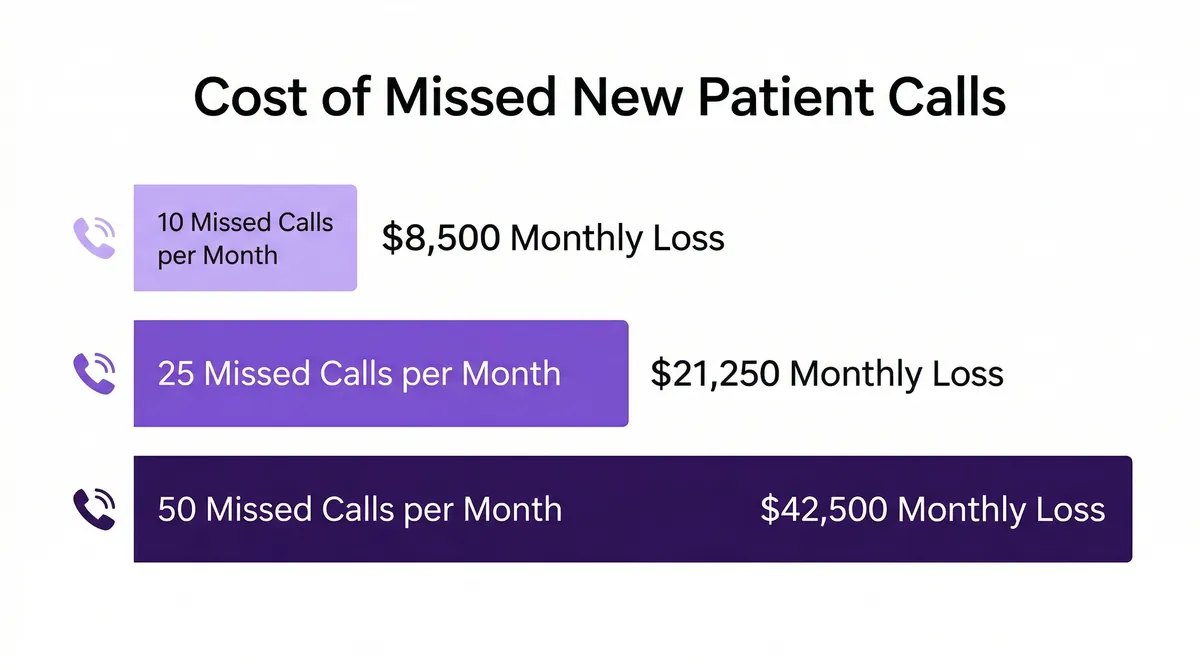
| Missed New Patient Calls/Month | Monthly Revenue Loss (First Visit) | Annual Lifetime Value Lost |
|---|---|---|
| 10 | $8,500 | $600,000–$960,000 |
| 25 | $21,250 | $1,500,000–$2,400,000 |
| 50 | $42,500 | $3,000,000–$4,800,000 |
Even at the conservative end — 10 missed new patient calls per month — you’re looking at over $100,000 in first-visit revenue lost annually and potentially $600,000 or more in lifetime value that your practice will never see.
Why Traditional Solutions Fall Short
Most practices have tried at least one fix. None of them fully work.
Voicemail is the default, but as the data shows, patients don’t use it. A 14–22% voicemail-leave rate means you’re losing the vast majority of after-hours and overflow callers outright.
Hiring additional front desk staff is the obvious answer, but it’s expensive. A full-time receptionist costs $35,000–$50,000 per year in salary alone, plus benefits, training, and turnover costs. And even with two receptionists, you still can’t cover lunch breaks, sick days, after-hours calls, or three simultaneous inbound calls.
Traditional answering services and call centers can pick up the phone, but they introduce new problems. Many use overseas operators who aren’t familiar with dental terminology. None integrate with your practice management software, which means they take a message and email it to your team — creating follow-up work and delays. The patient still doesn’t have an appointment when they hang up.
Each of these approaches addresses a symptom without solving the core problem behind missed dental patient calls: your phones need to be answered by someone (or something) that can actually schedule the patient, in real time, around the clock.
How AI Call Handling Eliminates Missed Dental Patient Calls
AI-powered dental receptionists represent a fundamentally different approach to missed dental patient calls. Instead of catching missed calls after the fact, they prevent them from happening at all.
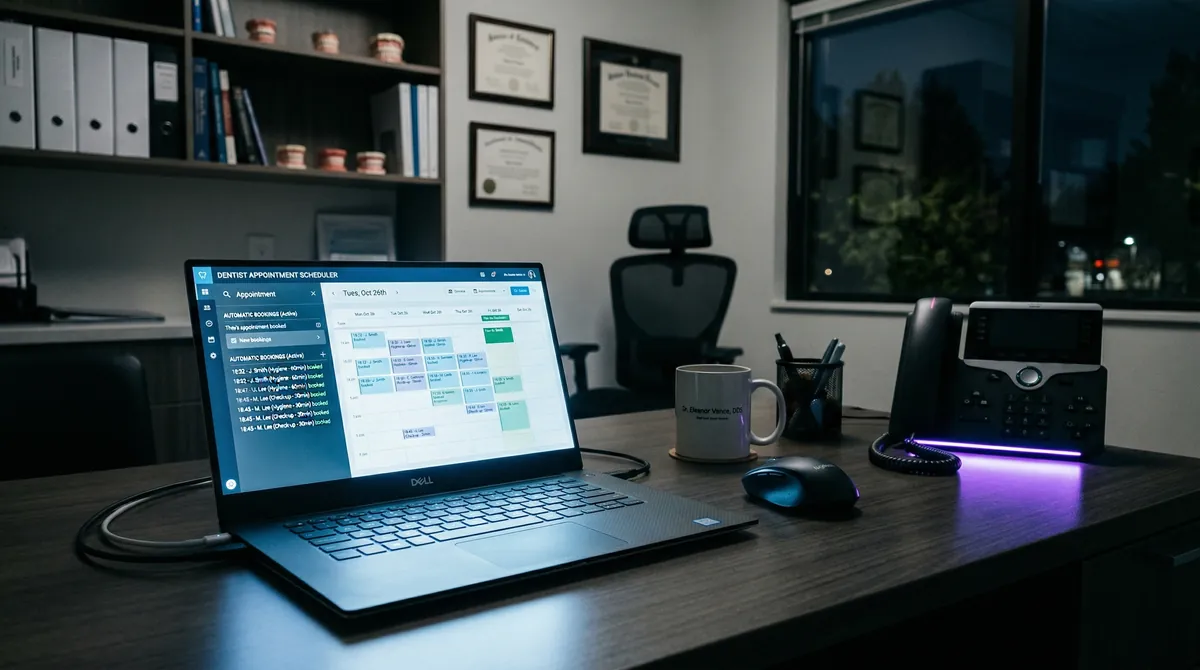
Here’s how it works: an AI receptionist answers every inbound call — first ring, no hold music, no voicemail tree. It understands natural language, responds conversationally, and handles the most common reason patients call: scheduling. Because it connects directly to your practice management system, it can check availability, book the appointment, and confirm it with the patient before the call ends.
Direct PMS Integration Changes the Game
The critical difference between an AI receptionist and a traditional answering service is what happens during the call. An answering service takes a message. An AI receptionist like Dentina.Ai books the appointment.
Dentina.Ai integrates with 14 major practice management systems — including Dentrix, Eaglesoft, Open Dental, Dentrix Ascend, eClinicalWorks, and Curve — so it schedules directly into your existing calendar. No follow-up calls from staff. No sticky notes. No lost messages. The patient calls, the appointment is booked, and your team gets a summary notification.
Practices using Dentina.Ai see a 100% call-answer rate with zero hold time. The system handles multiple simultaneous calls per location, speaks English and Spanish, and operates 24/7 — including weekends, holidays, lunch hours, and the after-hours window when many new patients research and call. One practice handled 221 calls during a 30-day trial period, resulting in 22 booked patients and over $50,000 in appointment value.
AI-powered platforms handle every call simultaneously — no hold queues, no voicemail, no patients lost to competitors during your lunch break.
Because the system is HIPAA-compliant with end-to-end encryption, patient data stays protected throughout every interaction. And because it works with major VOIP providers like Mango and Weave as well as traditional carriers like Spectrum and AT&T, implementation requires no changes to your existing phone number or system.
What to Do This Week to Start Recovering Lost Revenue
Reducing missed dental patient calls doesn’t require overhauling your entire front desk operation overnight. Start with three steps:
- Audit your missed call rate. Check your phone system’s call log for the past 30 days. Count total inbound calls, answered calls, and calls that went to voicemail or were abandoned. If your system doesn’t track this, that’s a data gap worth closing immediately.
- Calculate your monthly loss. Multiply your missed new patient calls by $850 (first-visit value). Then multiply by 12 for the annual impact. Most practice owners who run this calculation for the first time are shocked by the number.
- Test an AI call handling solution. Platforms like Dentina.Ai offer a free 30-day trial, so you can measure the impact on your own call data before committing. Route after-hours calls first, then expand to overflow during business hours once you see the results.
Conclusion
The practices that eliminate missed dental patient calls now will capture the revenue their competitors are still leaving on the table. Every day you wait is another set of calls — and patients — you’ll never get back.
Frequently Asked Questions
What percentage of dental office calls go unanswered?
Industry research consistently shows that 35–38% of calls to dental practices go unanswered during normal business hours. During lunch breaks, after-hours windows, and peak call periods, the rate can exceed 50%. A 2026 Peerlogic study tracking 4,280 calls across 26 practices confirmed a 38% unanswered rate.
How much does a missed patient call cost a dental practice?
Each missed new patient call represents approximately $850 in first-visit revenue. Over the patient’s lifetime with your practice, that value climbs to $5,000–$8,000. A practice missing just 10 new patient calls per month could be losing over $100,000 in first-visit revenue annually.
Can an AI receptionist really schedule dental appointments?
Yes. Modern AI receptionists like Dentina.Ai integrate directly with practice management systems such as Dentrix, Eaglesoft, and Open Dental. They check real-time availability and book appointments during the call — the patient hangs up with a confirmed appointment, no staff follow-up needed.
Does AI call handling work with my practice management software?
Most AI dental receptionists support the major PMS platforms. Dentina.Ai, for example, integrates with 14 systems including Dentrix, Dentrix Ascend, Eaglesoft, Open Dental, eClinicalWorks, Curve, Denticon, and others. It also works with VOIP providers like Mango and Weave and traditional carriers like Spectrum and AT&T.
What’s the difference between an AI receptionist and a dental answering service?
A traditional answering service takes a message and forwards it to your team for follow-up. An AI receptionist handles the entire interaction — answering questions, checking PMS availability, and booking the appointment in real time. The patient gets an immediate resolution, and your staff has no message backlog to work through.
Sources
Peerlogic — DSO Case Study: 4,280 Calls Across 26 Practices (2026) ·
Resonate AI — 18 Missed Calls in Dental Practices Statistics ·
DenteMax — Why Missed Phone Calls Are Dental Offices’ Largest Revenue Loss (2025) ·
Dental CPA — Why Every Missed Call Hurts Your Dental Practice (2025) ·
AgentZap — Dental Practice Phone Statistics: 15 Numbers Every Dentist Should Know (2026)