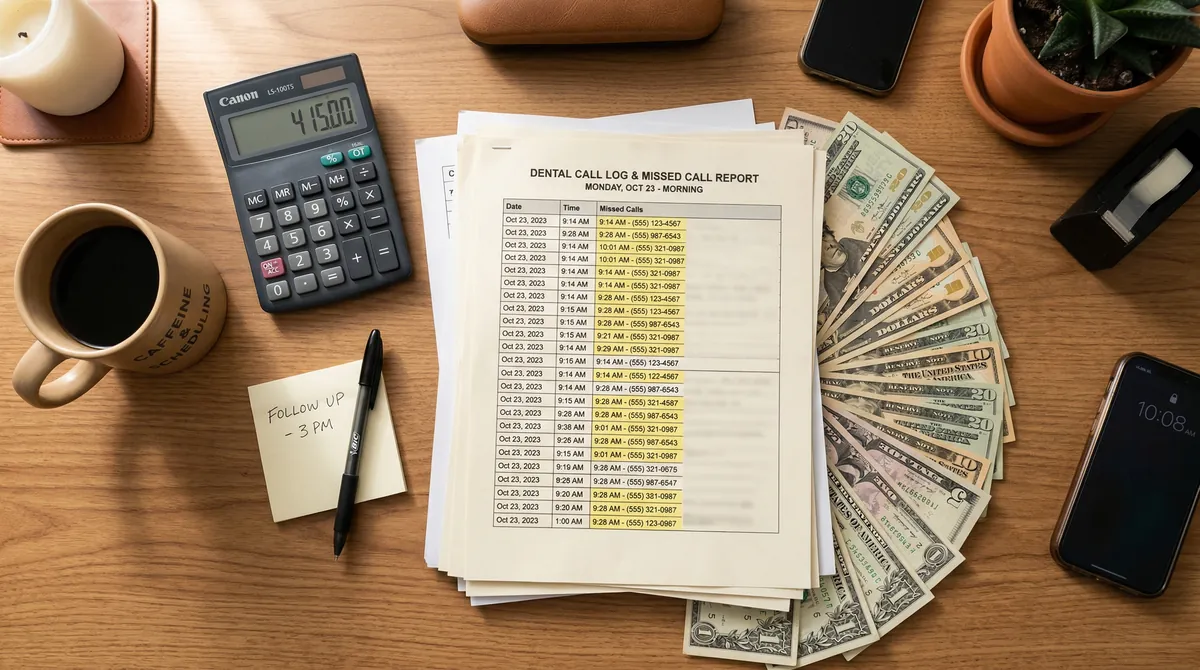
Your dental practice could be losing significant revenue — not from cancellations, insurance write-offs, or slow collections, but from phone calls that nobody picks up. If you’re wondering how to reduce missed calls dental office teams lose patients to, the answer starts with understanding the problem. Industry data shows that the average dental office misses 30% to 40% of incoming calls — a range confirmed by call tracking studies from Weave, TrueLark (analysis of 8 million patient conversations), and Peerlogic (study of 4,280 calls across 26 practices). Most of those callers never leave a voicemail — they simply call another practice.
This guide walks you through how to reduce the missed calls that dental office teams see every day, using a practical 30-60-90 day action plan. You’ll learn how to diagnose exactly when and why calls slip through the cracks, then layer in targeted fixes — from simple staffing tweaks to technology that eliminates the problem entirely. If you’ve been searching for how to reduce missed calls dental office teams deal with every day, this is your playbook.
Key takeaways: The average dental practice misses 30–40% of incoming calls, with peak losses during Monday mornings, lunch hours, and after hours. A phased 30-60-90 day plan — starting with missed-call text-backs and staggered lunch coverage — can improve your answer rate within the first week. Staffing tweaks and call routing push you to 80–85%, but AI-powered virtual receptionists are the only way to reach a true 100% answer rate with direct PMS scheduling, 24/7 coverage, and unlimited simultaneous calls.
- How Much Are Missed Calls Actually Costing You?
- Diagnose the Problem — When and Why Calls Go Unanswered
- How to Reduce Missed Calls Dental Office Teams Face: The 30-60-90 Day Plan
- Choosing the Right Technology to Eliminate Missed Calls
- Measuring Success — KPIs to Track After Implementation
- Your Next Step
- Frequently Asked Questions
How Much Are Missed Calls Actually Costing You?
Most practice owners know they miss some calls. Few realize the scale of the financial damage. According to call tracking data across North American dental practices, offices miss between 30% and 40% of inbound calls during business hours (per the Weave, TrueLark, and Peerlogic data cited above).
The real problem isn’t just the missed ring. It’s what happens next.
When you consider that the majority of those missed calls are patients trying to book appointments, the revenue impact adds up quickly. Each missed new patient call represents not just an immediate appointment but potential years of ongoing care and referrals.
And missed new patient calls are only part of the problem. Missed calls from existing patients — trying to reschedule, confirm, or ask about treatment — erode loyalty and push them toward practices that are easier to reach.
Diagnose the Problem — When and Why Calls Go Unanswered
Learning how to reduce the missed calls that dental office teams struggle with starts with understanding your practice’s specific missed-call pattern. A 5-operatory family practice in Phoenix will have different bottlenecks than a 12-chair DSO location in Miami. The diagnostic step is what separates practices that actually fix this problem from those that keep cycling through failed solutions.
Map Your Peak Call Windows
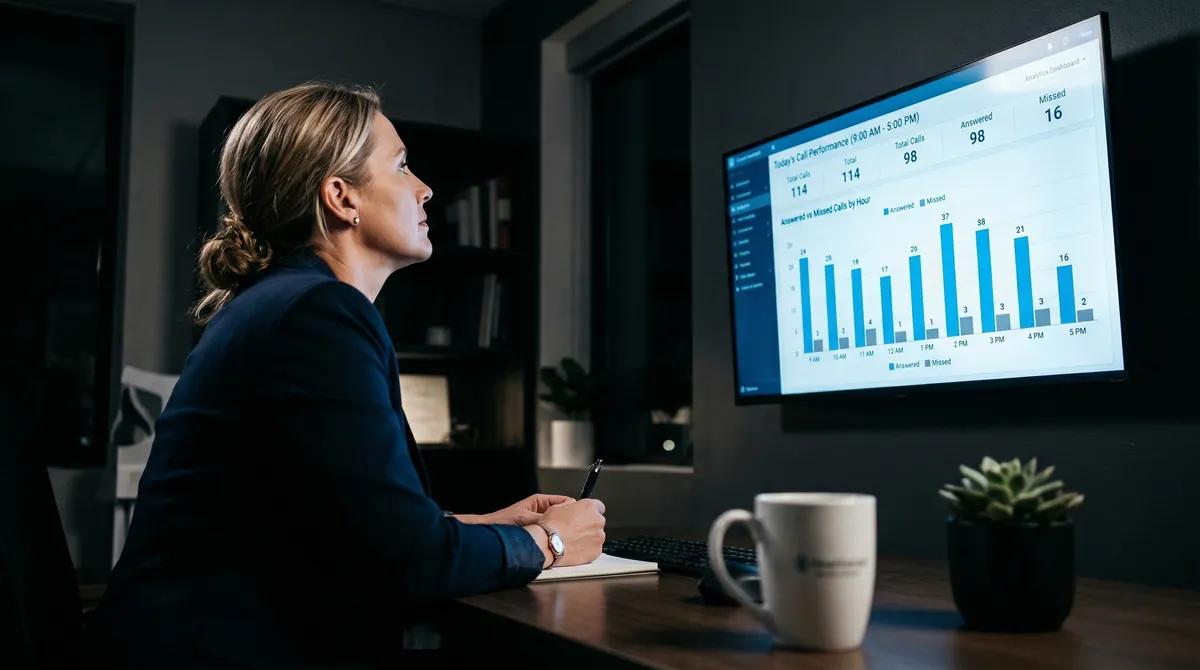
Pull your phone system’s call logs for the past two to four weeks and look for patterns. In most dental practices, the data tells a consistent story: Monday mornings are the single highest-volume window, with call traffic peaking between 10:00 and 11:00 AM across the rest of the week. A secondary spike typically hits between 2:00 and 3:00 PM.
Three time windows are especially dangerous for missed calls:
- Morning rush (8:00–11:00 AM): Patients call first thing, often while your team is simultaneously checking in the day’s first appointments, verifying insurance, and fielding walk-in questions.
- Lunch hour (12:00–1:00 PM): If your phones go to voicemail while the entire front desk takes lunch at once, you’re losing calls during a window when patients on their own lunch breaks have time to call.
- After hours and weekends: A significant share of appointment requests come outside of standard business hours. Every one of those goes to voicemail — or worse, a busy signal.
Identify the Root Causes
Once you see when calls are missed, look at why. The usual suspects are predictable:
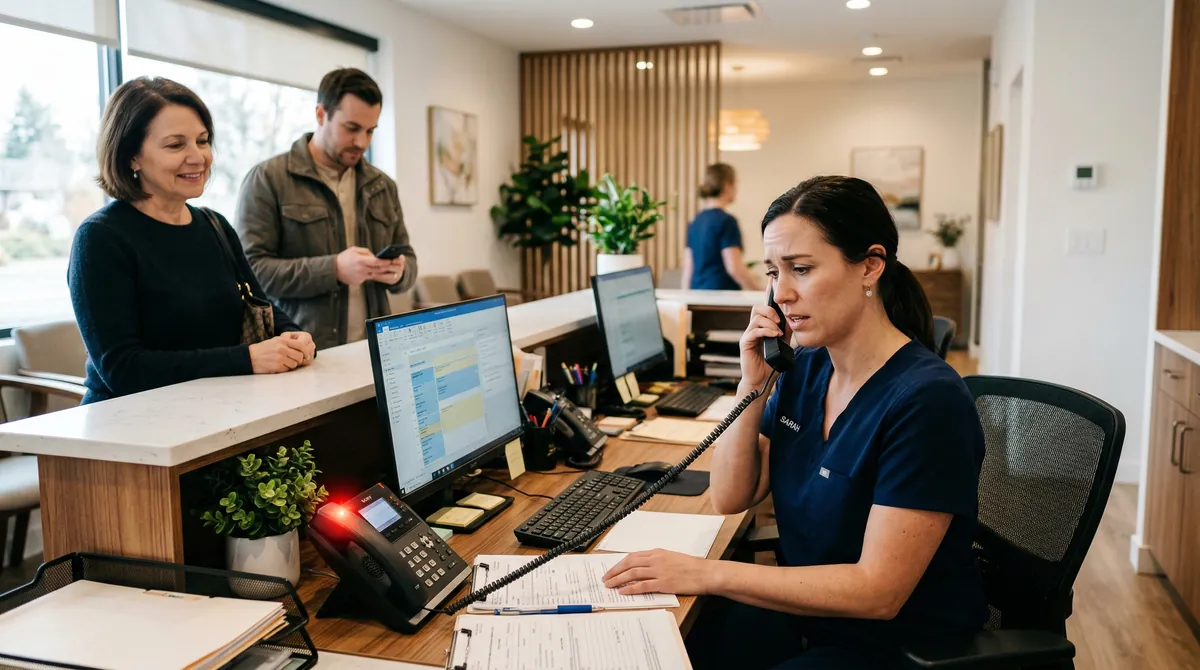
Staff multitasking is the number-one culprit. Your front desk team isn’t ignoring the phone — they’re juggling patient check-ins, insurance verification, treatment plan follow-ups, and in-person questions from patients and providers. When three calls come in while two patients are standing at the front desk, something has to give.
Single-line bottlenecks compound the issue. If your phone system doesn’t support simultaneous calls or efficient routing, callers get a busy signal or are stuck on hold long enough to hang up.
Seasonal spikes catch many practices off guard. January through March sees a surge from patients with refreshed insurance benefits. Back-to-school season (August–September) drives pediatric and orthodontic appointment volume. Without anticipating these spikes, your baseline staffing will be overwhelmed.
How to Reduce Missed Calls Dental Office Teams Face: The 30-60-90 Day Plan
Now that you’ve mapped the problem, here’s how to fix it — phased so you’re capturing more calls within the first week, optimizing within the first two months, and eliminating the problem by day 90.
Days 1–30: Quick Wins (Low Cost, High Impact)
These changes show how to reduce missed calls dental office teams see with minimal investment — and they can be implemented this week:
- Install call tracking. You can’t fix what you don’t measure. Tools like CallRail, Callbox, or your existing VoIP dashboard can show you exactly how many calls are missed, when they happen, and how long callers wait before hanging up. This data becomes your baseline.
- Set up a missed-call text-back. When a call goes unanswered, an automatic text message fires within seconds: “Hi, thanks for calling [Practice Name]. We missed your call — reply here to schedule or we’ll call you back shortly.” This works because many patients actually prefer texting over calling.
- Stagger lunch breaks. Never let the front desk go to lunch at the same time. Overlap shifts by 30 minutes so at least one person is always covering phones during the 12:00–1:00 PM window.
- Simplify your phone tree. If callers have to navigate more than two menu options before reaching a person, you’re increasing abandonment. Audit your IVR and strip it down to essentials: “Press 1 for appointments, press 2 for billing, or stay on the line.”
Days 31–60: Staffing and Routing Optimization
With your baseline data in hand, you can now make smarter resource decisions.
Add a dedicated phone person during peak hours. This doesn’t have to be a full-time hire. A part-time team member covering 9:00 AM to 1:00 PM, Monday through Wednesday, can dramatically improve your answer rate during the windows that matter most.
Implement call routing and overflow. Configure your phone system so that if the first extension doesn’t pick up within three rings, the call automatically rolls to a second extension, then a third. If no one is available, route to an overflow service rather than voicemail.
A typical mid-size dental practice receives 40 to 60 calls per day (solo practices may see fewer, while large DSO locations can exceed 100). During peak hours, that volume can concentrate into 40 to 50 calls within a two-hour window — far more than one or two front desk staff can handle.
Cross-train your clinical team. At minimum, one or two clinical staff members should be trained to answer the phone and schedule basic appointments. When the front desk is buried, having a backup who can grab the phone prevents calls from rolling to voicemail.
Days 61–90: Technology That Eliminates the Problem
Staffing improvements and call routing will get you from a 65% answer rate to maybe 80–85%. To truly solve the problem — to answer every call, every time — you need technology purpose-built for dental practices.
Traditional answering services were the go-to solution for decades, but they come with real limitations. Agents can take messages and transfer calls, but they can’t access your practice management system to actually book appointments. They charge per minute, making costs unpredictable. And quality varies wildly — a generic call center agent doesn’t know the difference between a crown and a cleaning.
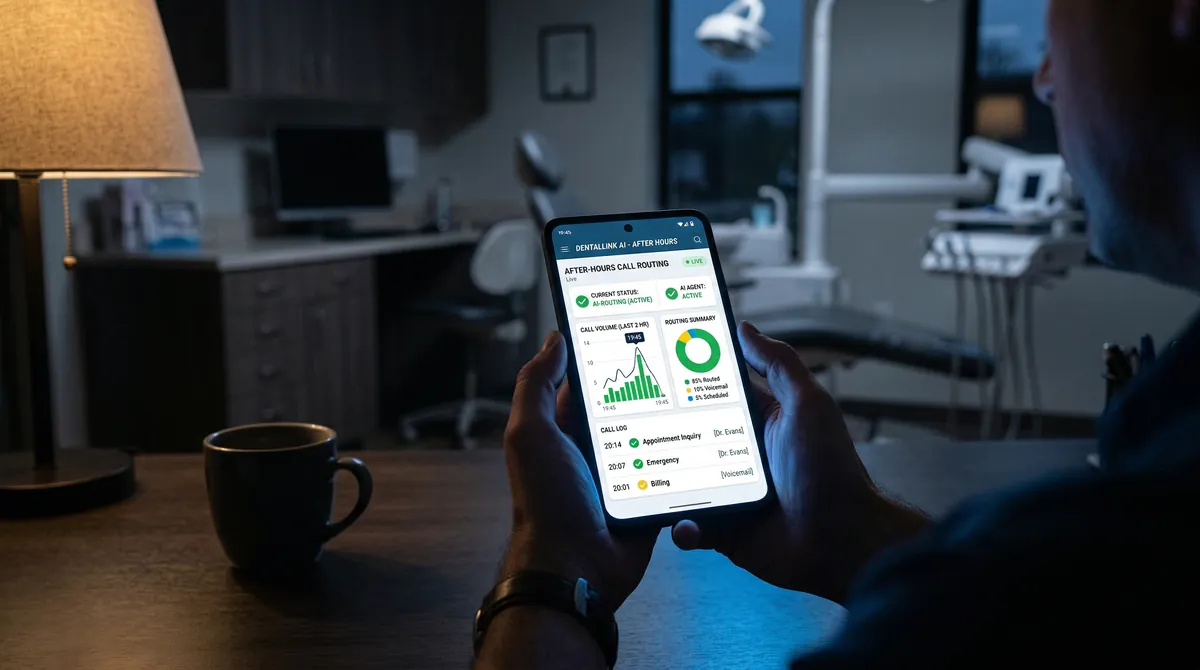
AI-powered virtual receptionists represent the current state of the art. The best solutions integrate directly with your PMS, answer calls in natural conversation, and handle scheduling, rescheduling, cancellations, and common patient questions without human involvement.
| Feature | Traditional Answering Service | AI Virtual Receptionist |
|---|---|---|
| Call answer rate | Varies (depends on agent availability) | 100% — unlimited simultaneous calls |
| Appointment scheduling | Message-taking only | Books directly into your PMS |
| After-hours coverage | Extra cost tier | 24/7 included |
| Multilingual support | Limited (Spanish common, others rare) | Up to 57 languages |
| HIPAA compliance | Varies by provider | HIPAA-aligned with BAA available |
| Cost model | Per-minute billing (typical) | Flat monthly rate |
| PMS integration | None | Direct integration (Dentrix, Eaglesoft, Open Dental, etc.) |
When evaluating AI solutions, prioritize the ones that integrate with your specific practice management system. Dentina.Ai, for example, integrates with 14 major PMS platforms — including Dentrix, Eaglesoft, Open Dental, and Denticon — so appointments are booked in real time without any manual re-entry by your staff.
Choosing the Right Technology to Eliminate Missed Calls
Not all AI receptionists are created equal. Knowing how to reduce missed calls dental office teams face means choosing the right technology. Here’s what to evaluate before committing:
PMS integration depth. Can the system read your schedule in real time and book directly, or does it just send you a message to book manually? The difference between these two is the difference between solving the problem and creating a new one. See all Dentina.Ai features →
Simultaneous call handling. During a Monday morning rush, you might have six calls come in within the same minute. A system that can only handle one call at a time doesn’t solve your bottleneck — it just moves it. Look for solutions that handle unlimited concurrent calls.
Language support. If your practice serves a multilingual community, your phone system needs to match. Some AI platforms support dozens of languages with natural-sounding voices and even handle code-switching — patients who mix English and Spanish in the same sentence, for instance.
Dentina.Ai supports 57 languages across five quality tiers, with multilingual code-switching for the top 10 languages — covering the vast majority of dental patients in the U.S. and Canada.
HIPAA compliance. Any system handling patient information over the phone must be HIPAA compliant with a signed Business Associate Agreement. This isn’t optional — it’s a legal requirement.
Contract flexibility. Avoid long-term lock-ins. Month-to-month agreements let you evaluate the technology with real data before committing. Dentina.Ai offers month-to-month contracts with annual discount options, plus a free trial to test with your actual call volume before you decide.
Measuring Success — KPIs to Track After Implementation
Once you’ve implemented these steps for how to reduce missed calls, dental office performance improves measurably. Track these metrics monthly to confirm you’re moving in the right direction:
- Call answer rate: Your north star metric. Target 95% or higher — and know that AI solutions can push this to 100%.
- Average speed to answer: Patients expect to reach someone within 3–4 rings. Anything beyond that increases abandonment.
- New patient conversion rate: Of the calls that are answered, what percentage result in a booked appointment? This tells you whether call quality is keeping pace with call quantity.
- After-hours booking volume: Once you implement 24/7 coverage, track how many appointments are booked outside business hours. This is pure incremental revenue you were previously leaving on the table.
- Patient satisfaction signals: Watch your Google reviews and patient feedback for mentions of phone experience. Practices that answer promptly and helpfully see it reflected in their ratings.
Review these metrics at the end of each month for the first quarter. By month three, you should have a clear picture of your ROI — and for most practices, the numbers make the case decisively.
Your Next Step
Every missed call is a patient choosing someone else. Now that you know how to reduce missed calls dental office practices lose patients to, the next step is action. The good news: this is one of the most fixable problems in dental practice management. Start this week by pulling your call logs and mapping when calls fall through. Layer in the quick wins from the 30-day phase while you evaluate longer-term technology solutions.
If you want to skip straight to a 100% answer rate, Dentina.Ai offers a free trial so you can see exactly how many calls it captures — and how many appointments it books directly into your PMS — before making any commitment. Try Dentina.Ai free for 30 days — or call (707) 336-8462 to hear it in action first →
The practices winning the most new patients aren’t necessarily the best clinicians. They’re the ones who answer the phone.
Frequently Asked Questions
What is a good call answer rate for a dental office?
A healthy dental practice should aim for a call answer rate of 90% or higher. Top-performing practices — especially those using AI-powered phone systems — consistently achieve 95–100%. If your answer rate is below 80%, you’re likely losing significant revenue to missed patient calls.
How many calls does the average dental practice miss per day?
With the average practice receiving 40–60 calls daily and missing approximately 35% (the midpoint of the 30–40% industry range), that translates to 14–21 missed calls per day. During peak periods like Monday mornings, the miss rate can climb even higher, especially if the front desk is handling in-person patients simultaneously.
Can AI receptionists actually schedule dental appointments?
Yes — modern AI receptionists like Dentina.Ai integrate directly with practice management systems such as Dentrix, Eaglesoft, and Open Dental. They can check real-time availability, book appointments, reschedule, and handle cancellations without any human involvement.
Are AI dental phone systems HIPAA compliant?
Reputable AI dental phone systems are fully HIPAA compliant and include a signed Business Associate Agreement (BAA). Always verify HIPAA compliance and request a BAA before implementing any technology that handles patient information over the phone.
How quickly can I reduce missed calls at my practice?
You can see measurable improvement within the first week by implementing missed-call text-backs and staggering lunch coverage. Full optimization — including AI-powered call handling — typically takes 60–90 days to fully deploy and fine-tune.
Sources
Weave — Dental Practice Call Analytics ·
TrueLark — Dental Communication Insights ·
Peerlogic — Dental Call Tracking Data ·
CallRail — Dental Call Tracking Solutions