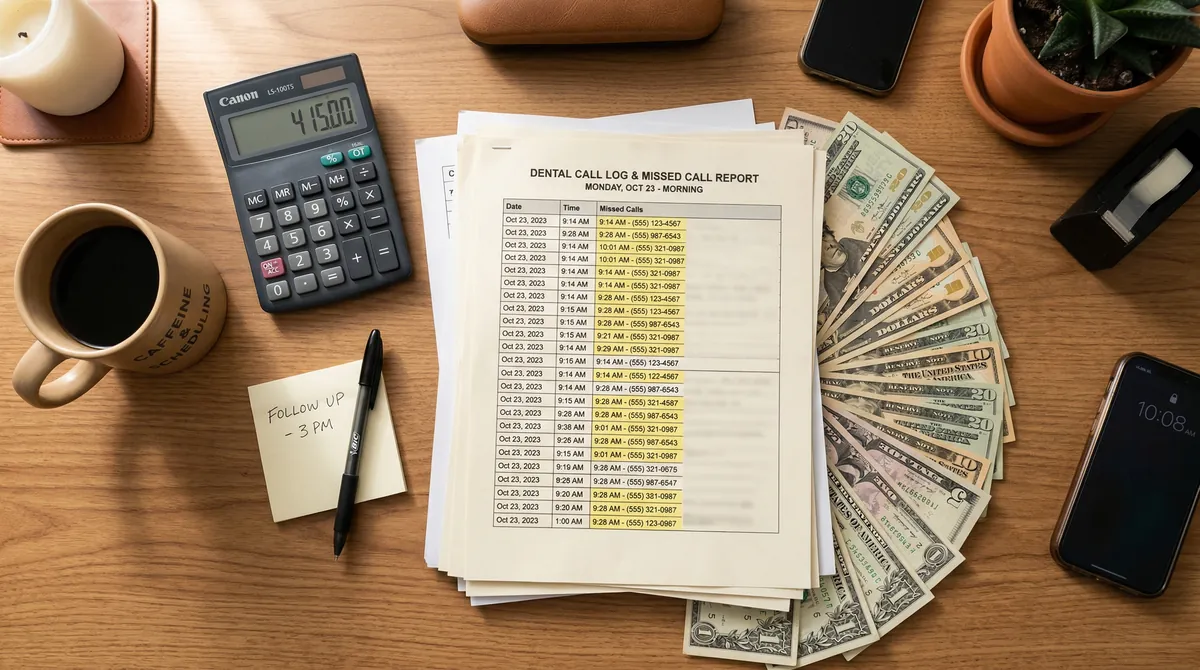
The average dental practice misses somewhere between 30% and 38% of its incoming phone calls. If those numbers sound high, consider that most of those unanswered calls happen during your busiest hours — when your front desk team is checking patients in, confirming insurance, or handling the lunch rush. The real question isn’t whether you’re missing calls. It’s what the cost of missed calls dental office owners silently absorb actually adds up to when you run the math.
This article walks you through a step-by-step financial breakdown so you can calculate your exact revenue loss — not just in first-visit dollars, but in the lifetime value walking out the door every time a phone goes unanswered. Whether you run a single-location practice or manage a multi-site DSO, these numbers will change how you think about your phones.
Key takeaways: The average dental practice misses 30–38% of incoming calls, and 78% of those callers never leave a voicemail — they simply call another office. When you factor in lifetime patient value of $8,000–$10,000 per patient, a typical 5-operatory practice loses $100,000 or more annually from unanswered calls alone. The cost of missed calls dental office teams face is one of the most measurable — and fixable — revenue leaks in dentistry, and AI-powered receptionists are recovering $5K–$10K+ per month for practices that address the problem.
- How Many Calls Is Your Practice Actually Missing?
- The Cost of Missed Calls Dental Office Owners Need to Calculate
- A Real Numbers Breakdown for a Typical Practice
- The Hidden Costs Beyond Lost Revenue
- How to Calculate the ROI of Fixing Your Missed Call Problem
- Stop Guessing — Start Measuring
- Conclusion
- Frequently Asked Questions
How Many Calls Is Your Practice Actually Missing?
Before you can calculate the cost, you need to understand the scope of the problem. Industry research paints a consistent picture: dental practices miss between 30% and 38% of all incoming calls during business hours. A 2025 analysis by DenteMax confirmed that missed phone calls remain the single largest source of revenue loss for dental offices, with the average practice failing to answer roughly one in three calls.
For a practice receiving 50 calls per day — a reasonable midpoint for a general practice with 4–6 operatories — that translates to 15–19 missed calls every single day. Over a month, that’s 300 to 380 calls that went to voicemail or rang out entirely.
The problem concentrates during peak hours. Call volume spikes between 10–11 AM and again around 2–3 PM, precisely when your front desk is juggling the most in-office activity. Lunch breaks, patient check-ins, insurance verifications, and treatment plan discussions all compete for your team’s attention. The phone doesn’t stop ringing just because the lobby is full.
Why the Problem Is Worse Than You Think
Here’s where the math gets painful. According to data compiled by Resonate AI, 78% of callers who reach a dental office voicemail hang up without leaving a message. They don’t wait. They don’t call back later. They’re gone.
Even worse, research from multiple industry sources shows that 67% of those callers immediately dial another dental practice. That means two out of every three missed callers become someone else’s patient — often within minutes of hanging up on your line.
So your effective “recovery rate” on missed calls is far lower than most practice owners assume. You’re not just missing calls — you’re actively sending patients to your competitors.
The Cost of Missed Calls Dental Office Owners Need to Calculate
Let’s build the calculation from the ground up. Grab your own call data and follow along — you can plug in your practice’s real numbers at each step.
Step 1 — Estimate Your Monthly Missed Calls
Start with your total monthly inbound calls. If you don’t track this, your phone system or VoIP provider should have reporting available. A general practice with 4–6 operatories typically receives 1,000–1,200 calls per month.
Multiply by your miss rate. If you don’t know yours, use the industry average of 35%.
Formula: 1,000 monthly calls × 35% miss rate = 350 missed calls per month
Step 2 — Apply the New Patient Conversion Rate
Not every missed call is a potential new patient. Some are existing patients calling to reschedule, ask a billing question, or confirm an appointment. Industry data suggests that roughly 30–40% of inbound calls to a dental practice are from prospective new patients or patients actively trying to book an appointment.
Apply the conservative end of that range:
350 missed calls × 35% new patient callers = ~123 potential new patients lost per month
Of those, assume a 50% conversion rate — meaning half would have actually scheduled if someone answered. That gives you roughly 61 lost appointments per month.
Step 3 — Calculate First-Visit Revenue Lost
The average new patient visit generates $250–$400 in production, depending on your fee schedule, payer mix, and whether the first visit includes diagnostics, imaging, and a treatment plan. Using the midpoint of $300:
61 lost appointments × $300 average first visit = $18,300 per month in immediate lost revenue
That’s $219,600 per year in first-visit production alone. But this number vastly understates the real damage.
Step 4 — Factor in Lifetime Patient Value
A patient who walks through your door for a first visit doesn’t just generate $300. If they become an active patient — returning for hygiene visits, accepting treatment plans, referring family members — industry benchmarks place their lifetime value between $8,000 and $10,000 for a general dental practice. Some estimates from dental consultants run as high as $22,000 when factoring in referrals and specialty work.
At an average lifetime value of $10,000 per patient, those 61 lost appointments per month represent $610,000 in lifetime revenue walking out the door — every single month.
Over a year, that’s $7.3 million in potential lifetime value that your practice never had a chance to capture. Even if you discount heavily for patients who would have churned or never completed treatment, the annualized cost of missed calls at your dental office easily exceeds six figures.
A Real Numbers Breakdown for a Typical Practice
Let’s put the full calculation in one place. Here’s a worked example for a mid-sized general dental practice — 5 operatories, 2 hygienists, one front desk team member answering phones:
| Metric | Your Practice | Example |
|---|---|---|
| Monthly inbound calls | ________ | 1,000 |
| Missed call rate | ________ | 35% |
| Missed calls per month | ________ | 350 |
| % that are new patient callers | ________ | 35% |
| Potential new patients missed | ________ | 123 |
| Booking conversion rate | ________ | 50% |
| Lost appointments per month | ________ | 61 |
| Avg. first-visit production | ________ | $300 |
| Monthly first-visit revenue lost | ________ | $18,300 |
| Avg. patient lifetime value | ________ | $10,000 |
| Monthly lifetime value lost | ________ | $610,000 |
| Annual first-visit revenue lost | ________ | $219,600 |
The “Your Practice” column is there for a reason. Pull your actual call data, run the formula, and see where you land. Most practice owners who do this exercise for the first time are stunned by the gap between what they assumed and what the numbers actually show.
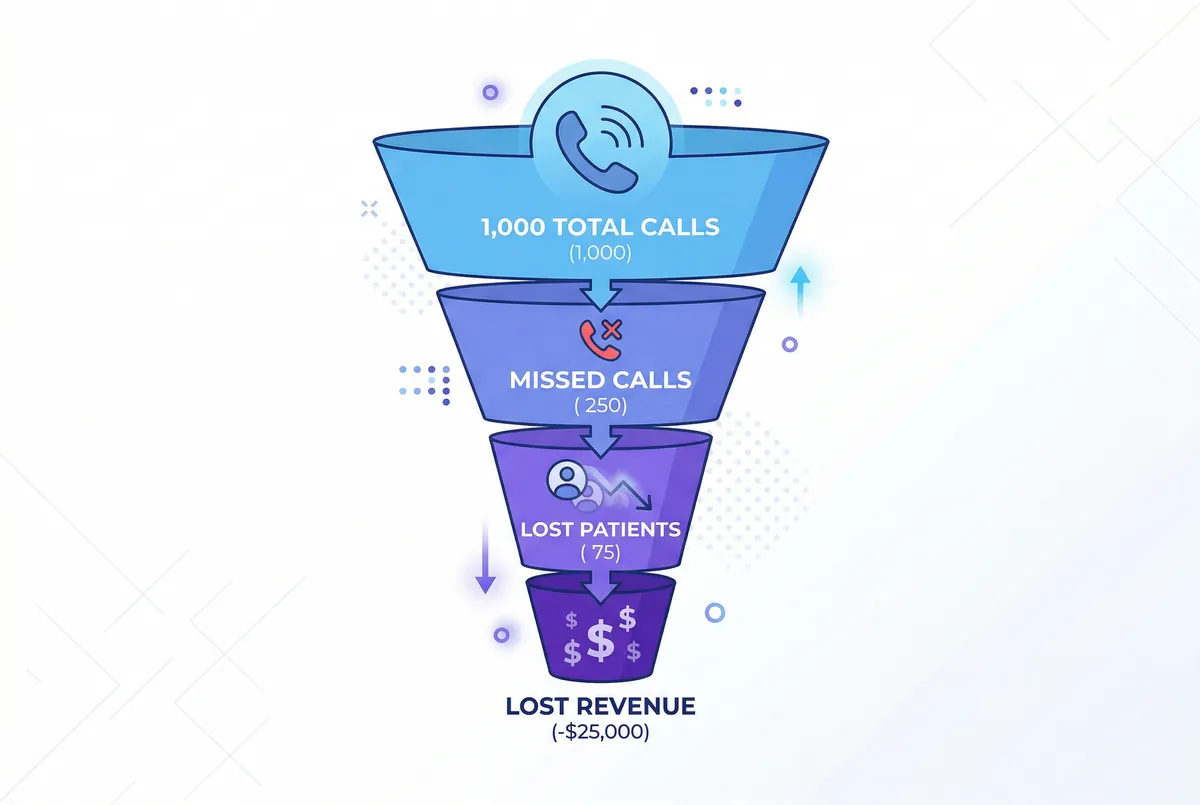
Even using conservative assumptions, a single-location general practice loses $100,000–$200,000 per year in immediate production from unanswered calls.
The Hidden Costs Beyond Lost Revenue
Beyond first-visit revenue, the cost of missed calls dental office managers need to account for includes several hidden drains. The direct revenue loss is only the most obvious line item. Missed calls create a cascade of secondary costs that compound over time.
Wasted marketing spend. You’re paying for SEO, Google Ads, mailers, and social media to make that phone ring. Every missed call from a marketing-generated lead means you paid for acquisition and got nothing in return. If you’re spending $100–$300 per new patient lead on Google Ads or direct mail — and 35% of those leads can’t reach you — you’re burning a significant share of your marketing budget before anyone picks up the phone.
Reputation damage. Patients who can’t reach your office don’t just disappear quietly. Some leave negative Google reviews citing difficulty getting through. Others mention it to friends and family. In a business built on referrals and local reputation, unreturned calls erode trust in ways that don’t show up on a P&L statement until it’s too late.
Staff burnout. When your team does try to return missed calls, they’re fighting an uphill battle. Callbacks have dramatically lower contact rates than live answers — many patients have already booked elsewhere by the time you call back. Your front desk ends up spending hours chasing voicemails with little to show for it, adding frustration and workload without proportional results.
Competitive leakage. A patient who books with another practice after your phone goes unanswered isn’t just a one-visit loss. They may stay with that practice for years or decades. You didn’t just miss a call — you funded a competitor’s patient acquisition with your own marketing dollars.

How to Calculate the ROI of Fixing Your Missed Call Problem
Once you know the cost of the problem, the next question is straightforward: what does it cost to fix it, and what’s the return?
Here’s how the three most common solutions compare:
| Solution | Monthly Cost | Availability | Books Into PMS? | Typical Recovery |
|---|---|---|---|---|
| Hire additional front desk staff | $3,000–$4,500 | Business hours only | Yes | Moderate — still limited by breaks, multitasking |
| Outsourced dental call center | $1,500–$3,000 | Extended hours | Rarely | Moderate — scripts vary, no PMS access |
| AI-powered receptionist | $299–$899 | 24/7/365 | Yes — direct scheduling | High — no hold times, instant booking |
The economics aren’t subtle. An AI receptionist like Dentina.Ai costs a fraction of a full-time hire and operates around the clock — including evenings, weekends, and holidays when traditional solutions go dark. Dentina.Ai practices see an average of 21 appointments booked per month per office, translating to $5,000–$10,000+ in recovered production. Top-performing offices report 40 or more bookings per month.
When your missed call problem costs $10,000–$18,000 per month in immediate production and a solution costs under $1,000 per month, the ROI calculation practically writes itself.
Why AI Outperforms Traditional Solutions
The advantage isn’t just cost. AI receptionists eliminate the root causes of missed calls entirely. There are no hold times, no lunch breaks, no sick days, and no limit on simultaneous calls. A platform like Dentina.Ai answers every call, schedules appointments directly into your practice management system, and handles routine questions — all while maintaining HIPAA compliance through a signed Business Associate Agreement.
For DSO operators managing multiple locations, the scalability is particularly compelling. Instead of staffing and training phone teams across sites, a single AI solution covers every location with consistent quality and zero ramp-up time.
Stop Guessing — Start Measuring
The biggest reason dental practices tolerate the cost of missed calls dental office managers rarely track is that they’ve never quantified the problem. If you’ve read this far, you now have the framework to change that.
Here’s your action plan:
- Pull your call data. Contact your phone system provider or VoIP dashboard and export your inbound call volume and answer rates for the last 90 days.
- Run the formula. Use the table above to calculate your monthly and annual revenue loss. Be honest with the numbers — rounding down won’t help you make better decisions.
- Benchmark monthly. Track your missed call rate as a KPI alongside production, collections, and new patient counts. What gets measured gets managed.
- Test a solution. If the numbers show what they typically show, explore an AI receptionist that can start recovering that revenue immediately. Most platforms, including Dentina.Ai, offer free trials so you can measure the impact before committing.
Conclusion
Every unanswered phone call at your dental practice carries a price tag — and it’s almost certainly larger than you thought. When you multiply a 35% missed call rate by real patient lifetime values of $8,000–$10,000, the cost of missed calls dental office teams ignore can easily exceed $100,000 annually in direct production loss, with millions more in lifetime value that never materializes.
The math is clear, the solutions exist, and the ROI is measurable in weeks, not years. The only question left is how long you’re willing to keep paying for calls that nobody answers.
See how Dentina.Ai recovers missed call revenue for dental practices →
Frequently Asked Questions
How many calls does the average dental office miss per month?
Industry data shows dental practices miss between 30% and 38% of incoming calls. For a practice receiving 1,000 calls per month, that means 300–380 calls go unanswered. The rate climbs during peak hours (10–11 AM and 2–3 PM) when front desk staff are managing in-office patients simultaneously.
What is the lifetime value of a dental patient?
The average lifetime value of a general dental patient falls between $8,000 and $10,000, based on annual hygiene visits, treatment acceptance, and retention over 8–12 years. Some dental consultants estimate the figure as high as $22,000 when factoring in referrals and specialty procedures.
How do I track my practice’s missed call rate?
Most VoIP phone systems and modern phone providers include call analytics dashboards that show total inbound calls, answered calls, missed calls, and average ring time. Contact your provider to activate reporting, then export the data monthly. Track it as a KPI alongside production and collections.
Can an AI receptionist really book appointments into my practice management system?
Yes. Modern AI receptionists like Dentina.Ai integrate directly with practice management software to check availability and schedule appointments in real time. This eliminates the callback loop that traditional answering services require, and ensures patients are booked before they hang up and call another office.
What’s the ROI of an AI receptionist compared to hiring more staff?
An AI receptionist typically costs $299–$899 per month compared to $3,000–$4,500 for an additional front desk employee. AI solutions also operate 24/7 with no breaks, sick days, or overtime. Dentina.Ai offices average 21 appointments booked per month, generating $5,000–$10,000+ in production — a return of 5–30x the monthly cost.
Sources
DenteMax — Why Missed Phone Calls Are Dental Offices’ Largest Revenue Loss (2025) ·
Resonate AI — 18 Missed Calls in Dental Practices Statistics ·
Resonate AI — 19 Call Answering Rates in Dental Clinics Statistics ·
Dandy — Lifetime Value of a Dental Patient ·
Darkhorse Tech — Average Lifetime Value of Your Dental Patients ·
Peerlogic — Turning Missed Dental Phone Calls Into Profit ·
Overjet — Average Dental Practice Revenue in 2025