Walk past the front desk of almost any busy dental practice and you’ll see the same scene: a phone ringing, a patient waiting at the counter, an insurance portal open on one screen, and the schedule open on another. Dental front desk burnout isn’t a personality problem or a work-ethic problem. It’s a math problem — one person, five jobs, and a phone that never stops.
The numbers back this up. A 2026 State of Work Report from GoTu, produced with the American Dental Hygienists’ Association and drawing on nearly 8,000 respondents, found that more than 54% of dental professionals report burnout, as reported by Becker’s Dental, with workload ranked as the top contributing factor. And replacing a burned-out team member is harder than ever — 62% of dentists called staffing shortages their biggest practice challenge, according to ADA Health Policy Institute data reported by ADA News.
The good news: you can take real pressure off your front desk without adding another salary to payroll. Here’s how.
What’s Driving Dental Front Desk Burnout
Before you can fix the problem, it helps to name what’s actually causing it. Three root causes show up in practice after practice.
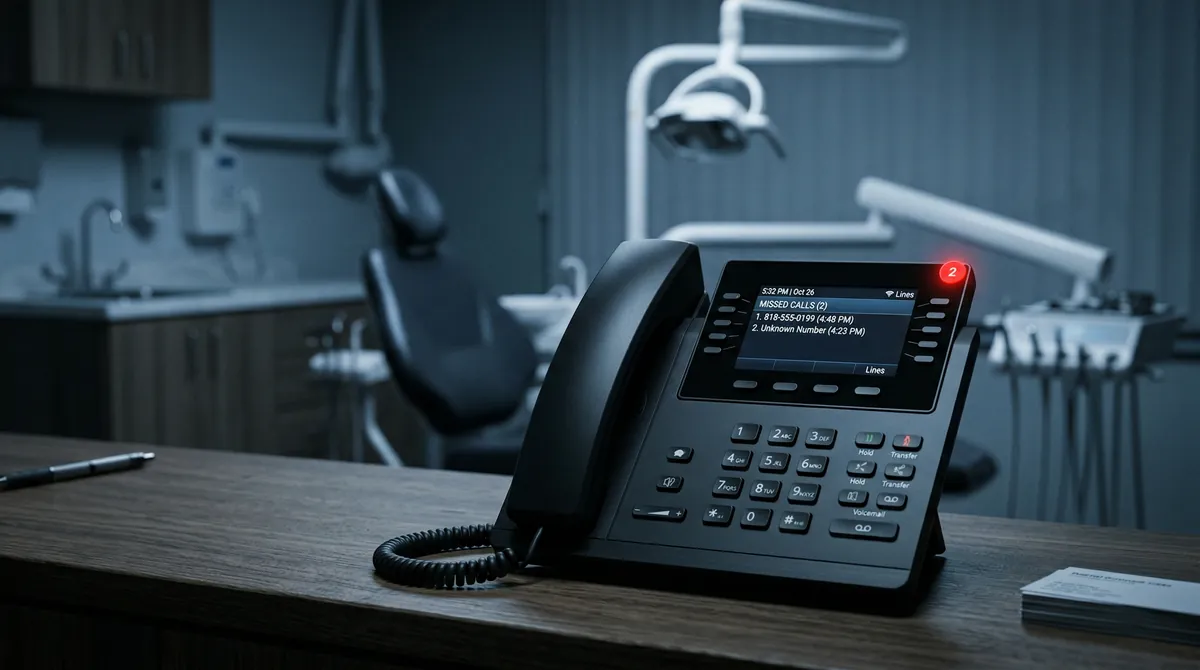
1. Phone overload. The phone is the single biggest interrupter at the front desk. Every ring forces a choice: abandon the patient standing in front of you, or let the call go to voicemail. Dental Economics has reported that nearly one third of all calls to a dental office are missed — and that 87% of new patients sent to voicemail or put on hold without a proper greeting hang up and never call back. Your team knows this, which is exactly why every unanswered ring adds stress.
2. Constant multitasking. The modern front desk role has quietly expanded far beyond scheduling. As Dental ClaimSupport notes, front-office team members now handle insurance eligibility checks, billing follow-ups, treatment estimates, and difficult financial conversations — often all in the same hour. Context-switching all day, every day, is a fast track to exhaustion.
3. Understaffing and thankless-role fatigue. In the DentalPost 2025 salary report covered by DentistryIQ, front office professionals described feeling like “second class” team members compared to clinical staff, and only 42.6% of practice managers said they were satisfied with their pay — down from 49.3% two years earlier. When one person leaves, the workload lands on whoever remains, and the cycle accelerates.
The Real Cost of an Overwhelmed Front Desk
Burnout isn’t just uncomfortable — it’s expensive. Three costs compound quietly.
- Lost new patients. Most practices miss 30–40% of inbound calls. Many of those callers are new patients who simply dial the next practice on their search results. A single lost new patient can represent thousands of dollars in lifetime production — we break down the full math in the true cost of missed calls.
- Turnover and retraining. In the GoTu survey, roughly half of burned-out respondents said they had considered leaving dentistry entirely, and over half had changed offices. Every departure means weeks of recruiting, onboarding, and mistakes while a new hire learns your systems.
- Degraded patient experience. A frazzled front desk shows. Patients feel rushed at checkout, calls get shorter and colder, and the warm first impression that builds a practice slowly erodes.
Here’s the part many owners miss: hiring another receptionist often doesn’t fix any of this. The new hire inherits the same ringing phone and the same interrupt-driven day. The workload needs restructuring, not just redistribution.
How to Reduce Dental Receptionist Workload Without Hiring

You don’t need a bigger team. You need fewer interruptions reaching the team you have. These five changes deliver the most relief for the least cost.
1. Take routine calls off your team’s plate. Track your calls for one week and you’ll find that the majority are routine: scheduling, rescheduling, cancellations, hours, directions, insurance participation. None of these need a human who is simultaneously checking in patients. Automating routine call handling — with an AI receptionist or structured phone tree — removes the single largest source of front desk interruptions.
2. Set up smart call routing. Not every call deserves equal urgency. Route after-hours and lunch-hour calls to automated handling. Send billing questions to the person who actually handles billing. Flag true emergencies for immediate attention. When calls arrive pre-sorted, your team stops playing dispatcher.
3. Protect focus time for admin work. Insurance verification and claims follow-up need sustained concentration. Block 60–90 minutes of phone-free time per day for each front desk team member, with calls covered by automation or a rotating teammate. Uninterrupted admin time gets done in half the hours and with fewer errors.
4. Offer online self-scheduling and two-way texting. Many patients — especially younger ones — prefer to book or confirm without a phone call at all. Every appointment booked online or confirmed by text is a call that never rings.
5. Write down who gets alerted for what. A surprising amount of front desk stress comes from being the human switchboard: “Who needs to know about this?” Define simple alert rules — emergencies go to the doctor’s cell, billing questions go to the office manager, new patient inquiries get same-day follow-up — so the right person is notified automatically and nothing depends on one overwhelmed brain.
How Dentina.Ai Helps
This is the problem Dentina.Ai was built to solve. Dentina is an AI dental receptionist that answers your phones 24/7 — after hours and during overflow, when your staff are busy or the lines are full. That means a 100% answer rate: every ring, no limits, with no cap on simultaneous calls.
Dentina doesn’t just take messages. It books, reschedules, and cancels appointments directly in your practice management system in real time, following your own scheduling rules and provider availability. It integrates with major systems including Open Dental, Dentrix Ascend, Curve Dental, Eaglesoft, Cloud9, Denticon, Dolphin, and OrthoTrac. Across all practices, Dentina handles 15,000+ calls every day, and 94% of calls are resolved without a human transfer — so your front desk only gets involved when a call genuinely needs them.
The burnout-specific details matter most:
- Emergencies are identified, not missed. Dentina recognizes emergency calls, schedules urgent appointments, and notifies your staff by email or text with clearly marked high-priority alerts.
- Custom alert rules in plain English. Practices can enable custom alert rules — plain-English conditions like “text me if a caller mentions severe swelling” — so the right person is notified automatically.
- Every call is documented. After each call, your team gets an email summary with the key details, plus full transcripts and recordings in an online portal. No more scribbled sticky notes or “who took that call?”
- Billing calls get routed, not absorbed. Dentina collects the caller’s information and alerts the right staff member to follow up — on their schedule, not mid-check-in.
- Ten languages. Patients can choose from English, Spanish, French, German, Hindi, Russian, Portuguese, Japanese, Italian, and Dutch, so language barriers never land on your front desk.
The results are concrete: practices book 21 appointments per office per month on average with Dentina.Ai, representing $5K–$10K+ in production value per month — captured from calls that would otherwise hit voicemail. And your team gets what no new hire can give them: a phone that has already been answered. Calls are handled under HIPAA-compliant policies, and every practice receives a Business Associate Agreement.
Give Your Front Desk Room to Breathe
Dental front desk burnout doesn’t resolve on its own, and it rarely resolves by adding one more person to the same broken workflow. It resolves when the interruptions stop — when the phone is covered, urgent calls reach the right person automatically, and your team can focus on the patients standing in front of them.
If you want to see what that feels like, Dentina.Ai offers a 30-day free trial with no setup fees and a month-to-month agreement. Book a demo at dentina.ai/book-a-demo — or just imagine your front desk on a Monday morning where every call is already answered.
Frequently Asked Questions
What causes burnout at the dental front desk?
The three biggest drivers are phone overload (constant interruptions from inbound calls), nonstop multitasking across scheduling, insurance, and billing, and understaffing that concentrates the workload on fewer people. Industry surveys show workload is the top contributing factor to burnout among dental professionals.
How can I reduce front desk workload without hiring another receptionist?
Start with the phone, since it’s the biggest interrupter: automate routine calls like scheduling, rescheduling, and office-hours questions, and route after-hours and overflow calls to an AI receptionist. Block daily phone-free time for insurance and billing work, and offer online self-scheduling and text confirmations so fewer calls ring in the first place. Finally, define automatic alert rules so urgent calls reach the right person directly.
Do patients accept talking to an AI receptionist?
Yes. Patients care most about being answered quickly and getting what they called for — an appointment, an answer, or a message delivered. Dentina.Ai resolves 94% of calls without a human transfer, and callers who need a person are routed to one based on your practice’s call-routing preferences.
Will an AI receptionist work with my practice management software?
Dentina.Ai integrates in real time with major practice management systems including Open Dental, Dentrix Ascend, Curve Dental, Eaglesoft, Cloud9, Denticon, Dolphin, and OrthoTrac. It books, reschedules, and cancels appointments directly in your PMS following your scheduling rules and provider availability.
Is an AI dental receptionist HIPAA compliant?
Dentina.Ai operates under HIPAA-compliant policies and provides every practice with a Business Associate Agreement. Calls are handled with the same privacy and security standards as the rest of your office.
Sources
Becker’s Dental — Over Half of Dental Professionals Dealing With Burnout: Report (2026) ·
ADA News — Five Years Later: Staffing Shortages, Infection Control Since the COVID-19 Pandemic (2025) ·
Dental Economics — Phone Calls: Are You Losing Patients at “Hello”? (2018) ·
Dental ClaimSupport — Front Office Turnover in Dentistry ·
DentistryIQ — Dental Front Office 2025 Salary Report: Loves, Hates, and More Insights (2025)