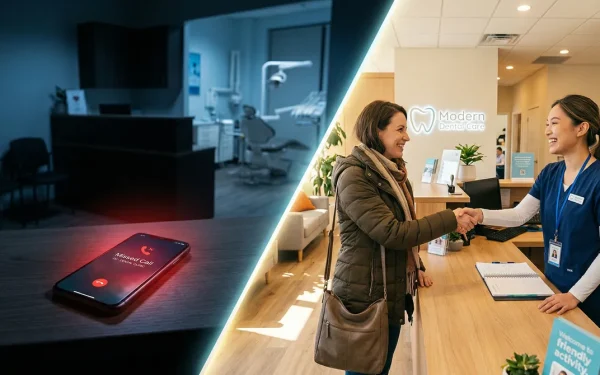
You spend thousands of dollars each month on dental SEO, Google Ads, and social campaigns to make your phone ring. But what happens when it does — and nobody picks up? Your dental marketing phone answer rate is the most overlooked metric in practice growth, and it could be draining your budget without you ever realizing it.
This article breaks down exactly how unanswered calls sabotage your marketing ROI, what the real numbers look like, and how to calculate the dollars you’re leaving on the table every month. If you’re investing in marketing but not seeing the patient volume to match, the problem might not be your ads — it might be your phone.
Key takeaways: The average dental practice fails to answer 32–38% of incoming calls during business hours, and 87% of new patients sent to voicemail never call back, according to dental industry data widely cited by Dental Economics and other practice management sources. For a practice spending $4,000 per month on marketing, that translates to roughly $1,200–$1,500 in wasted ad spend each month — money that generated a ringing phone but never produced a conversation. AI-powered call answering solutions like Dentina.Ai eliminate this gap by ensuring 100% of calls are answered and routed to real scheduling outcomes.
- The Marketing-to-Phone Pipeline Most Practices Ignore
- What the Data Says About Your Dental Marketing Phone Answer Rate
- How to Calculate Your Wasted Marketing Dollars
- Why Front Desks Can't Keep Up (And It's Not Their Fault)
- Closing the Gap Between Marketing Spend and Patient Conversion
- Conclusion
- Frequently Asked Questions
The Marketing-to-Phone Pipeline Most Practices Ignore
Dental marketing — whether it’s SEO, PPC, direct mail, or social media — has one primary job: make the phone ring. According to industry data, phone calls remain the dominant conversion path for dental practices. While online booking has grown, the majority of new patients still pick up the phone, especially for higher-value services like implants, orthodontics, or emergency care.
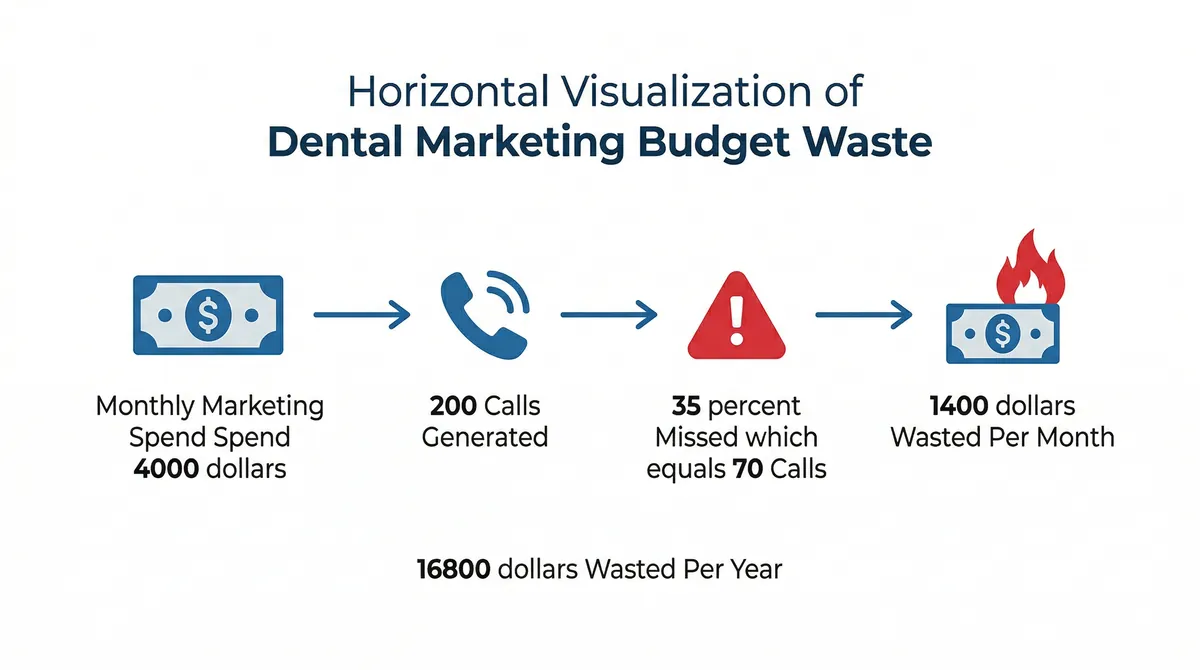
Here’s where the disconnect happens. Most practices evaluate their marketing by looking at impressions, clicks, and call volume. They see 200 calls last month, and the marketing agency reports strong numbers. But the real question is: how many of those 200 calls turned into a human conversation?
If your front desk answered 130 of those calls and missed 70, your marketing didn’t generate 200 leads. It generated 130. The other 70 were just noise — expensive noise you paid for.
Phone calls account for over 60% of new patient inquiries at the average dental practice, yet most marketing dashboards don’t track whether those calls were actually answered.
This blind spot is why so many practices feel like their marketing “isn’t working” when, in reality, the marketing is doing its job. The phone system isn’t.
What the Data Says About Your Dental Marketing Phone Answer Rate
The Industry Benchmarks
Multiple studies paint a consistent picture: dental practices miss a significant share of incoming calls. Research from call-tracking platforms and industry analysts shows that 32–38% of calls to dental practices go unanswered during regular business hours. That’s not after hours. That’s Monday through Friday, 8 a.m. to 5 p.m.
To put it differently, if your practice receives 50 calls per day, between 16 and 19 of them ring out or hit voicemail — every single day.
| Metric | Industry Average | Top-Performing Practices |
|---|---|---|
| Call answer rate | 62–68% | 90%+ |
| Calls missed during business hours | 32–38% | Under 10% |
| New patient calls that reach voicemail | ~35% | Under 5% |
| Answered calls converted to appointments | 53% | 75% |
What Happens When a New Patient Hits Voicemail
The data on caller behavior after reaching voicemail is stark. According to industry benchmarks, 87% of new patients who are sent to voicemail never call back. They don’t leave a message. They don’t try again tomorrow. They hang up and search for the next practice on the list.
Only about 14% of new patients bother leaving a voicemail when their call goes unanswered. The rest — 86% — simply move on. And where do they go?
67% of patients who reach voicemail at a dental practice call a competitor instead.
That’s not a slow leak. That’s a fire hose of potential revenue pointed directly at your competitors, funded entirely by your marketing budget.

How to Calculate Your Wasted Marketing Dollars
This is where the dental marketing phone answer rate moves from an abstract problem to a concrete dollar figure. Here’s the formula:
- Monthly marketing spend — what you pay for SEO, PPC, and other campaigns that drive calls
- Calls generated — total inbound calls attributed to marketing
- Cost per call — divide spend by calls (e.g., $4,000 ÷ 200 calls = $20 per call)
- Missed call rate — percentage of calls not answered (industry average: 35%)
- Wasted spend — cost per call × number of missed calls
Let’s walk through a real-world example:
| Line Item | Your Practice |
|---|---|
| Monthly marketing spend | $4,000 |
| Marketing-generated calls | 200 |
| Cost per call | $20 |
| Missed call rate | 35% |
| Missed calls per month | 70 |
| Wasted marketing spend per month | $1,400 |
| Wasted marketing spend per year | $16,800 |
That’s $16,800 per year buying phone rings that nobody answered. And that only accounts for the marketing dollars wasted — not the downstream revenue lost.
When you factor in new patient lifetime value, the picture gets worse. With the average new dental patient worth between $800 and $1,200 in first-year revenue and $8,000 or more over their lifetime, those 70 missed calls per month could represent over $50,000 in lost first-year revenue alone — assuming even a conservative 50% conversion rate on answered calls.
A practice missing 35% of marketing-generated calls wastes approximately $16,800 in ad spend per year — before counting the $600,000+ in lifetime patient value those calls represented.
Why Front Desks Can’t Keep Up (And It’s Not Their Fault)
Before pointing fingers, it’s worth understanding why even excellent front desk teams miss calls. The structural problem isn’t effort — it’s physics. A single receptionist can only handle one call at a time, and dental front desks are expected to simultaneously check patients in and out, verify insurance, collect copays, answer questions from clinical staff, and manage the schedule.
During peak hours — typically 10 a.m. to noon and 2 p.m. to 4 p.m. — call volume spikes while the front desk is already at full capacity. Lunch breaks create another gap. Staff PTO, sick days, and turnover create more.
The result is predictable and consistent across practices of every size: phones go unanswered during the exact hours when marketing-generated calls are most likely to come in. A potential new patient clicks your Google Ad at 11 a.m., calls your office, hears four rings and a voicemail greeting, and hangs up. Your PPC dashboard records a successful conversion. Your practice records nothing at all.

Closing the Gap Between Marketing Spend and Patient Conversion
Audit Your Current Answer Rate
The first step is measurement. If you don’t know your dental marketing phone answer rate, you can’t fix it. Here’s how to get a baseline:
- Check your call-tracking platform. If your marketing agency uses a tool like CallRail, CallTrackingMetrics, or similar, request a report showing total calls, answered calls, missed calls, and voicemail rate — broken down by hour of day and day of week.
- Review your phone system logs. Most VoIP systems log every inbound call with a disposition (answered, missed, voicemail). Pull 30 days of data and calculate your answer rate.
- Run a mystery shopper test. Have someone call your office at different times over two weeks and record how many times the call goes unanswered or hits voicemail.
If you find your answer rate is below 90%, you have a measurable marketing leak.
AI-Powered Call Answering as the Missing Link
Hiring additional front desk staff to cover every gap is one option, but it’s expensive and still doesn’t solve for sick days, simultaneous calls, or after-hours. This is where AI-powered phone answering changes the equation.
Platforms like Dentina.Ai function as an AI receptionist that answers every call — no ring-outs, no voicemails, no hold music. The AI handles scheduling directly in your practice management system, answers routine questions, speaks 57 languages, and works 24/7. It integrates with 14 major dental PMS platforms including Dentrix, Open Dental, Eaglesoft, and Denticon.
The impact on your dental marketing phone answer rate is immediate: it goes from whatever your current rate is to 100%. Every dollar you spend driving phone calls now reaches a live conversation. Every SEO click, every Google Ad, every social campaign that generates a call results in someone (or something intelligent) actually picking up.
For practices already spending on marketing, this isn’t an additional cost — it’s the fix that makes your existing spend work. If you’re currently wasting $1,400 per month on unanswered calls, even a fraction of that recovered revenue pays for the solution many times over.
Conclusion
The math is straightforward. When 35% of your marketing-driven calls go unanswered, and 67% of those callers phone a competitor instead, your marketing budget is effectively subsidizing your competition’s patient growth. You’re paying for the Google Ad, the SEO ranking, the social media post — and they’re getting the patient.
Start by measuring your answer rate. Then calculate the waste. And then decide whether you’re comfortable writing that check every month — or whether it’s time to ensure every call your marketing generates actually reaches a conversation.
If you want to see what a 100% answer rate looks like in practice, Dentina.Ai offers a free trial so you can test it with your own call volume and PMS before committing.
Frequently Asked Questions
What is a good phone answer rate for a dental practice?
Top-performing dental practices answer 90% or more of incoming calls. The industry average is significantly lower, hovering around 62–68%. If your practice answers fewer than 80% of calls, you likely have a measurable revenue leak tied to your marketing spend.
How much does a missed call cost a dental practice?
The direct marketing cost of a missed call depends on your cost per call — typically $15–$50 for PPC-generated calls. But the real cost is the lost patient. With average first-year patient revenue between $800 and $1,200, and lifetime value exceeding $8,000, a single missed new patient call can cost far more than the ad spend that generated it.
Do patients leave voicemails at dental offices?
Very rarely. Research shows only about 14% of new patients leave a voicemail when their call goes unanswered. The vast majority — 86% — hang up without leaving a message. Most will immediately call a competing practice instead of waiting for a callback.
How can a dental practice answer 100% of calls?
The only reliable way to achieve a 100% answer rate is with AI-powered phone answering that handles calls around the clock — including during peak hours, lunch breaks, after hours, and weekends. AI receptionists like Dentina.Ai answer every call instantly, schedule appointments directly into your PMS, and handle routine inquiries in 57 languages without putting any caller on hold.
Sources
Reach — 32% of Dental Calls Go Unanswered ·
Dental CPA — Why Every Missed Call Hurts Your Dental Practice (2025) ·
RevUp Dental — The Real Cost of Acquiring New Patients ·
ViziSites — Dental Marketing Budget Blueprint (2025) ·
Incept Health — Average Cost Per Acquisition for New Dental Patients ·
AgentZap — Dental Practice Phone Statistics: 15 Numbers Every Dentist Should Know (2026)