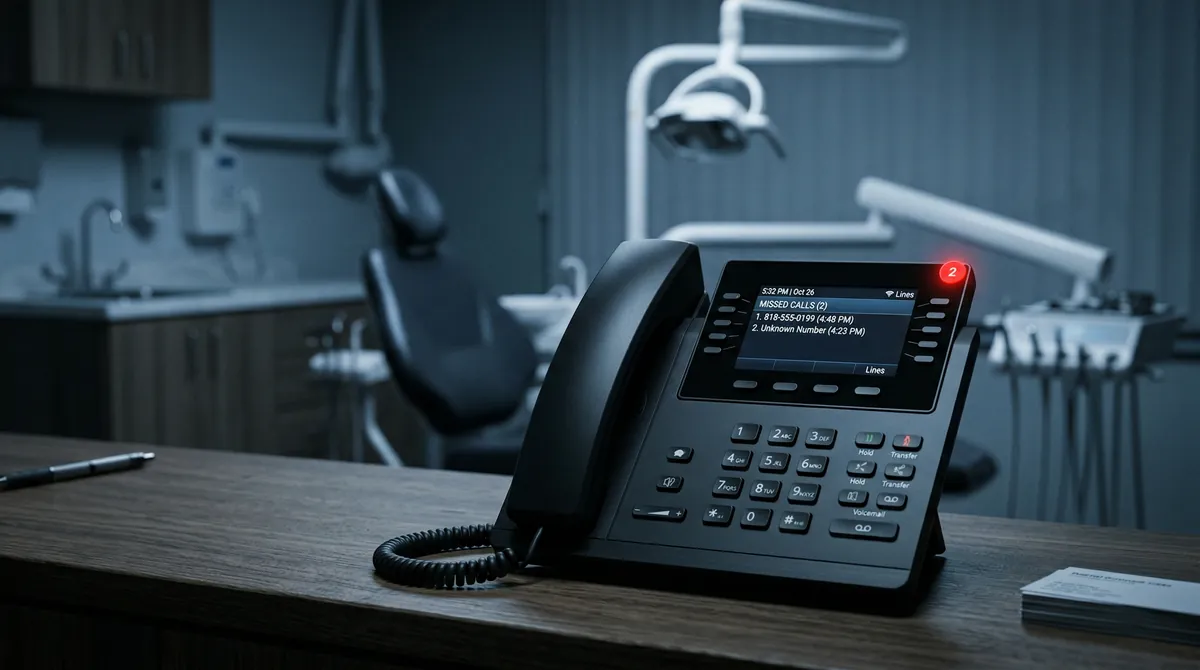
Your front desk team is on a call. A second line rings. A potential new patient hears four rings, then voicemail. They hang up and dial the practice down the street.
That 30-second interaction — or lack of one — just cost your practice somewhere between $250 and $10,000, depending on how you measure it. And it probably happened several times today.
If you’ve ever wondered how much revenue lost missed calls dental practices face every day, this article gives you the exact formula, real numbers, and a tiered breakdown so you can calculate your own losses in under five minutes.
Key takeaways: The average dental practice misses 32–38% of incoming calls. Each missed new-patient call represents $250–$350 in immediate first-visit revenue and $10,000+ in lifetime patient value. A mid-size practice receiving 800 calls per month can lose over $151,000 annually from unanswered calls alone. Solutions like AI-powered call answering, staff phone training, and smart call routing can close the gap.
- How Many Calls Is Your Practice Actually Missing?
- How Much Revenue Lost Missed Calls Dental Practices Face Yearly
- Revenue Loss by Practice Size: Three Scenarios
- Where Missed Calls Hurt the Most
- The Hidden Multiplier: Lifetime Patient Value
- How to Stop the Revenue Leak
- Run the Numbers for Your Practice
- Conclusion
- Frequently Asked Questions
How Many Calls Is Your Practice Actually Missing?
Most practice owners assume their team answers nearly every call. The data tells a different story — and understanding how much revenue is lost from missed calls dental offices face is the first step to fixing it.
A 2026 case study by Peerlogic, which tracked 4,280 inbound calls across 26 dental practices, found that 38% of calls went unanswered during normal business hours. Other industry analyses put the number between 32% and 35%. Even at the conservative end, roughly one in three callers never reaches a human.
The average dental practice misses 32–38% of incoming phone calls during regular business hours — and only about 14% of new patients leave a voicemail (Resonate AI).
That voicemail stat is the real kicker. When a prospective patient can’t get through, they don’t wait. Industry data suggests only 14% of new patients leave a voicemail when calls go unanswered — the rest move on to other providers (Resonate AI).
Why It Happens
Missed calls aren’t a staffing failure — they’re a structural problem. Front desk teams juggle check-ins, insurance verification, treatment plan questions, and patient checkout simultaneously. Calls pile up during predictable crunch times:
- Monday mornings — weekend emergencies and appointment requests flood the lines
- Lunch hours — reduced staffing while call volume stays steady
- Hold-time abandonment — research suggests that patients placed on hold for more than 60 seconds hang up at significantly higher rates
- After hours — evenings and weekends account for a large share of missed opportunities, since many patients call outside 9-to-5
Industry surveys consistently show that a majority of offices with high missed-call rates cite staff shortages as the primary cause — a finding supported by data from the ADA Health Policy Institute and Oral Health Group. The problem isn’t effort — it’s bandwidth.
How Much Revenue Lost Missed Calls Dental Practices Face Yearly
Here’s the formula that turns your missed calls into a dollar figure. Every variable is something you can pull from your own call reports and practice management system.
Monthly Revenue Lost = Missed Calls per Month × New Patient Call Rate × Answer-to-Appointment Rate × Average First-Visit Production
Let’s break down each piece:
- Missed Calls per Month — Check your phone system or answering service reports. If you don’t track this, estimate 32–35% of your total inbound calls.
- New Patient Call Rate — What percentage of your inbound calls are new patient inquiries? Industry benchmarks put this at 25–35%. A common figure is 30%.
- Answer-to-Appointment Rate — When your team does answer a new patient call, how often do they book an appointment? The industry average is about 50%, though top-performing practices hit 75–85%.
- Average First-Visit Production — The revenue generated from a new patient’s first appointment. For general dentistry, this typically ranges from $250 to $350, depending on your payer mix and exam scope (Dental Economics).
A Worked Example
Take a mid-size general practice receiving 800 inbound calls per month:
- Missed calls at 35% = 280 missed calls
- New patient calls at 30% = 84 missed new patient calls
- Appointment conversion at 50% = 42 lost appointments
- First-visit production at $300 = $12,600 lost per month
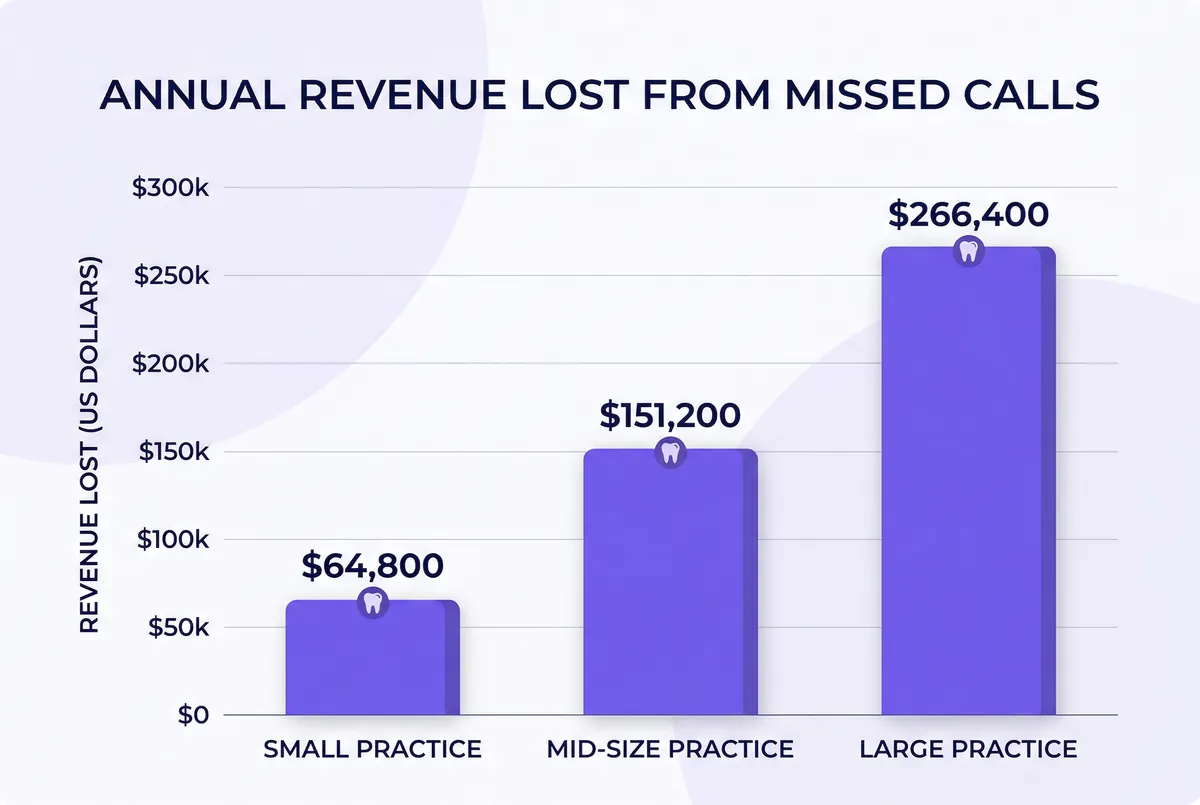
That’s $151,200 per year — a stark example of how much revenue lost missed calls dental offices generate — walking out the door — or rather, never walking in.
And that only captures first-visit revenue. It doesn’t account for the treatment plans, hygiene recalls, and referrals each of those 42 patients would have generated over the following years.
Revenue Loss by Practice Size: Three Scenarios
Not every practice looks the same. Here’s how the numbers shift across small, mid-size, and large or multi-location practices. All scenarios use a 30% new patient call rate, 50% appointment conversion, and $300 average first-visit production — adjust these to match your practice for a more precise estimate.
| Metric | Small Practice | Mid-Size Practice | Large / DSO Location |
|---|---|---|---|
| Total Calls / Month | 400 | 800 | 1,300+ |
| Missed Call Rate | 30% | 35% | 38% |
| Missed Calls / Month | 120 | 280 | 494+ |
| Missed New Patient Calls | 36 | 84 | 148+ |
| Lost Appointments / Month | 18 | 42 | 74+ |
| Monthly Revenue Lost | $5,400 | $12,600 | $22,200+ |
| Annual Revenue Lost | $64,800 | $151,200 | $266,400+ |
| 10-Year Lifetime Value Lost* | $180,000+ | $420,000+ | $740,000+ |
*Lifetime value estimated at $10,000 per patient over 8–10 years, applied to lost appointments per month.
This shows how much revenue lost missed calls dental offices face — even a small solo practice losing 18 potential appointments per month is leaving an estimated $64,800 in first-visit revenue on the table every year — and more than $180,000 in lifetime patient value.
For DSO executives managing multiple locations, multiply these figures across your portfolio. A 10-location group at the mid-size tier is looking at over $1.5 million in annual first-visit revenue loss from missed calls alone.
Where Missed Calls Hurt the Most
Not all missed calls carry equal weight. Understanding when and where the highest-value calls slip through helps prioritize your fix.
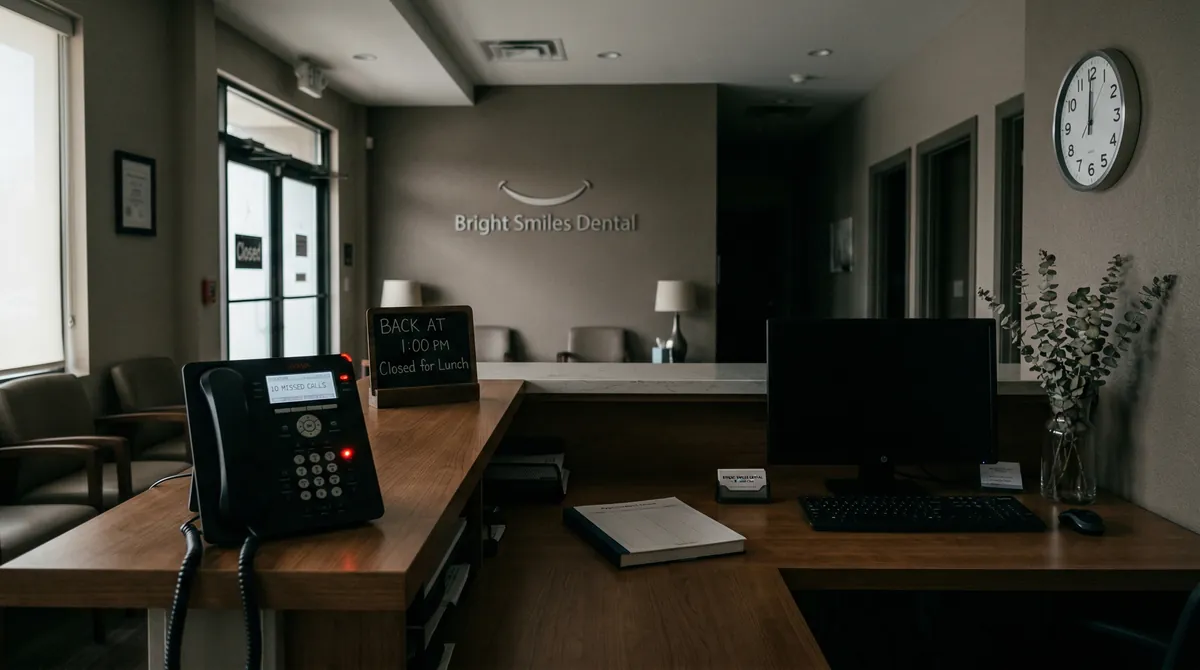
After-hours calls represent a disproportionate share of new patient inquiries. People research dentists in the evening, on weekends, and during their own lunch breaks — exactly when most offices are closed or short-staffed. Practices without after-hours call coverage lose these callers entirely.
Monday mornings see the highest call volume of any weekday for most dental offices. Weekend emergencies, patients calling to reschedule, and new inquiries all converge in the first two hours of the week. If your front desk is also checking in the morning’s patients during that window, the phone becomes an afterthought.
Hold-time abandonment is the silent killer. Even when your team answers, putting a caller on hold for more than 60 seconds dramatically increases the chance they hang up. The caller technically “reached” your office but still didn’t convert.
The Hidden Multiplier: Lifetime Patient Value
First-visit revenue tells only a fraction of the story. The real cost of a missed call compounds over years.
The commonly cited lifetime value of a dental patient is $10,000, based on twice-yearly hygiene visits, periodic restorative work, and the occasional larger procedure. Some consultants put the figure considerably higher — dental practice growth consultant Derek Naylor, frequently cited in industry analyses, estimates $22,000, and practices with strong case acceptance on comprehensive treatment plans can see even more.
A single unanswered phone call from a new patient doesn’t cost you $300. It costs you $10,000 or more in lifetime production — plus the referrals that patient would have sent your way.
Referrals add another layer. Satisfied dental patients typically refer multiple friends or family members over their lifetime with a practice. Each of those referrals carries its own lifetime value, creating a compounding effect that makes each missed new patient call exponentially more expensive than it first appears.
When a practice consultant tells you “every new patient call matters,” this is the math behind that statement. A practice missing 42 new patient appointment opportunities each month isn’t just losing $12,600 in immediate production. It’s forgoing $420,000+ in lifetime value — every single month.
How to Stop the Revenue Leak
The good news: this is one of the most fixable revenue problems in dentistry. You don’t need to hire three more front desk staff. You need to close the gaps in your call coverage.
AI-Powered Call Answering
Modern AI receptionist platforms can answer every call — during business hours, after hours, weekends, and holidays — and book appointments directly into your practice management system. There’s no hold time, no voicemail, and no missed opportunities.
Dentina.Ai, for example, integrates with 14 major dental PMS platforms including Dentrix, Open Dental, Eaglesoft, and Denticon. The AI answers in 57 languages, handles scheduling, rescheduling, and cancellations, and transfers complex calls to your team when needed. Based on Dentina.Ai customer data, practices using Dentina see an average of 262 calls handled per month with 21 additional appointments booked — representing $5,000 to $10,000+ in estimated recovered monthly revenue (based on 21 appointments at $250–$350 average first-visit production) that would have otherwise gone to voicemail.
Staff Phone Training
For the calls your team does answer, conversion training pays for itself many times over. The gap between an average practice (50% conversion) and a top performer (80% conversion) on a base of 84 answered new patient calls per month is 25 additional appointments — or $7,500 per month at $300 per first visit. Scripts, role-playing, and call recording review are the fastest levers to pull here.
Smart Call Routing
If every call hits the same front desk phone, you’re creating a bottleneck. Implementing call routing that sends overflow calls to a secondary line, an AI answering system, or a trained remote receptionist ensures coverage even during your busiest moments. The goal is simple: never let a call go to voicemail during the times when new patients are most likely to be calling.
Run the Numbers for Your Practice
Now you know how much revenue lost missed calls dental practices leave on the table. The formula works with your real data. Pull your call volume from your phone system, check your missed-call rate, and plug in your first-visit production average. If the result surprises you, you’re not alone — most practice owners underestimate this loss by 50% or more.
For practices looking to close the gap immediately, an AI-powered receptionist can start answering calls within days of setup, with no hardware changes and direct integration into your existing PMS. It’s the fastest path from “missed call” to “booked appointment” — and from revenue lost to revenue recovered.
See how Dentina.Ai works for your practice →
Conclusion
Every unanswered call has a price tag — and for most practices, the total is far larger than they realize. Whether your practice loses $64,000 or $266,000 per year depends on your call volume, miss rate, and how you measure value. The formula is straightforward: calls × miss rate × value per patient = revenue at risk.
The highest-ROI fix is also the simplest: answer every call. If you want to see how an AI receptionist captures the calls your team can’t get to — and books them directly into your PMS — schedule a quick demo with Dentina.Ai or call our demo line at (707) 336-8462 to hear it yourself.
Frequently Asked Questions
How much does one missed call cost a dental practice?
The immediate cost depends on whether the caller was a new patient. If they were, the average first-visit production loss is $250–$350. However, the true cost is the patient’s lifetime value — estimated at $10,000 or more over 8–10 years of regular visits and treatment.
What percentage of dental office calls go unanswered?
Industry data consistently shows that 32–38% of calls to dental offices go unanswered during business hours. A 2026 Peerlogic study of 26 practices found a 38% miss rate. After hours, the rate approaches 100% for practices without overflow coverage.
Do patients leave voicemails when they can’t reach a dental office?
Very rarely. Only about 14% of new patients leave a voicemail. The vast majority will call a competing dental office instead. This means each unanswered call has a high probability of becoming a permanently lost patient.
How can I find out how many calls my practice is missing?
Check your phone system’s call analytics or ask your VoIP provider for a missed-call report. Many modern phone systems track answered, missed, and abandoned calls automatically. If yours doesn’t, a call tracking service can be added for a few dollars per month.
Can an AI receptionist really book dental appointments?
Yes. AI receptionist platforms like Dentina.Ai integrate directly with practice management systems such as Dentrix, Open Dental, and Eaglesoft. They can check real-time availability, book appointments, send confirmations, and handle rescheduling or cancellations — all without human intervention.